

 Slovensky (EUR)
 Česky (CZK)
 Magyar (HUF)
Atherosclerosis and cholesterol: how arterial plaque forms
Atherosclerosis and cholesterol: how arterial plaque forms
Atherosclerosis is a long-term process in artery walls in which arterial plaque develops. Cholesterol-containing lipoprotein particles, vessel wall cells and inflammatory mechanisms all contribute.
We explain how plaque forms, how it differs from a blood clot, and what LDL-C, HDL-C, non-HDL cholesterol, apoB and Lp(a) mean. Blood test results are assessed alongside overall cardiovascular risk.
01 · What is atherosclerosis?
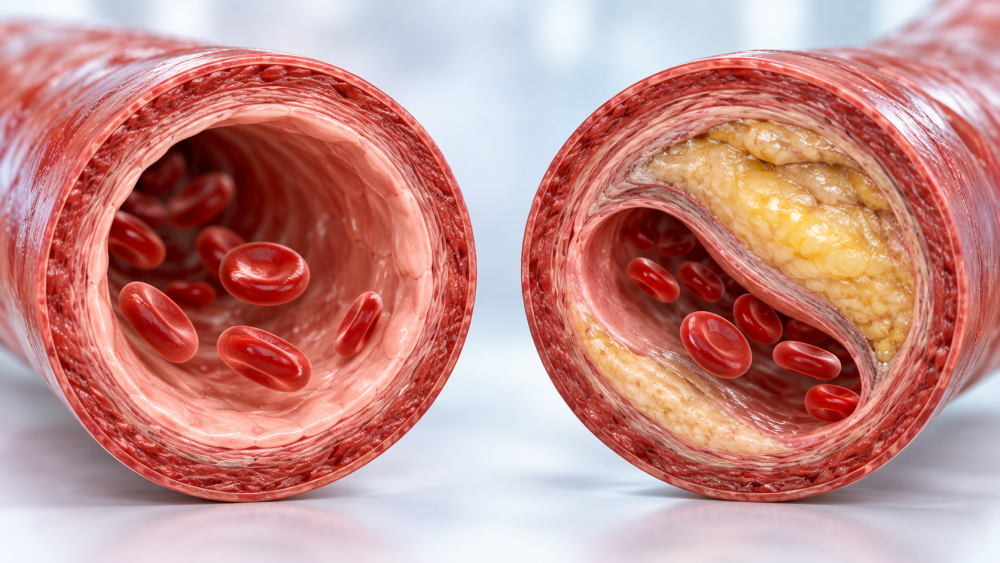
Atherosclerosis is a chronic process in artery walls in which atherosclerotic plaque gradually develops. It involves more than simple fat deposits. Cholesterol-containing lipoproteins, vessel wall cells, immune and inflammatory mechanisms, and other risk factors all contribute.
Plaque can alter the vessel wall's structure and restrict blood flow. A clinical problem can also arise when plaque is disrupted and a blood clot subsequently forms.
For how this relates to circulation, see the main article: Heart and blood vessels.
02 · How does vascular plaque form?
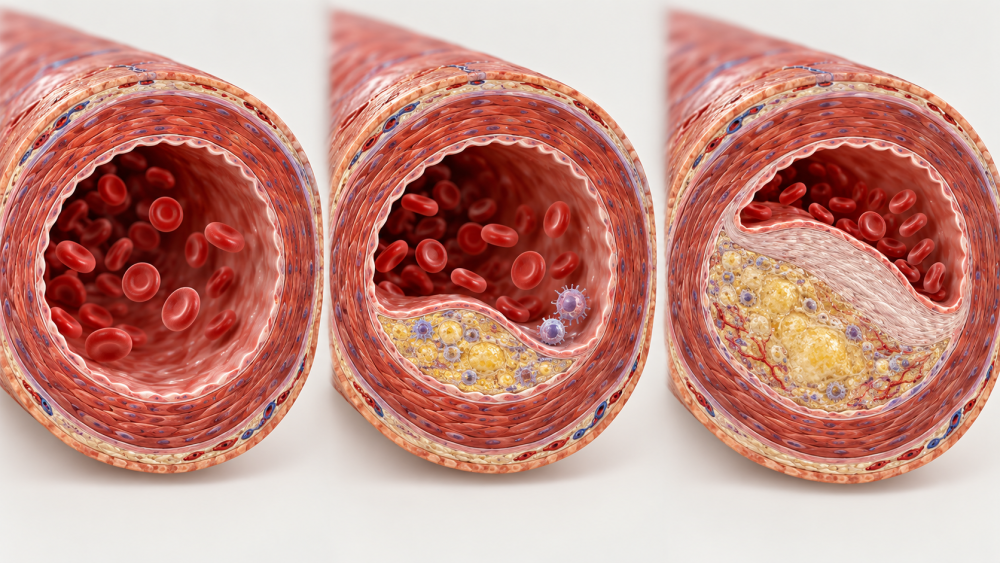
In simplified terms, the process involves long-term interactions between the vessel wall and atherogenic lipoproteins. Particles containing apoB can enter the artery wall and become retained there. Cellular and inflammatory mechanisms then become involved, and plaque may gradually grow and change.
The endothelium regulates many processes between blood and the vessel wall.
Lipoproteins containing apoB play an important role.
Immune cells respond to retained lipoproteins.
Its composition and stability can change over time.
Macrophages, cells of the immune system, take up lipids and can become foam cells. Plaque can contain lipids, cellular debris and fibrous tissue. Its development differs from person to person.
Plaque is a change in the artery wall. A blood clot can form on its disrupted surface and suddenly restrict or stop blood flow. This is more complex than a piece of fat simply coming loose from a pipe.
For the role of the inner lining of arteries, see Endothelium: the living lining of blood vessels.
03 · Cholesterol and lipoproteins
Cholesterol is necessary for the body. Because it does not dissolve in water, it travels in blood within particles called lipoproteins. It is therefore useful to distinguish cholesterol itself from the particles that carry it.
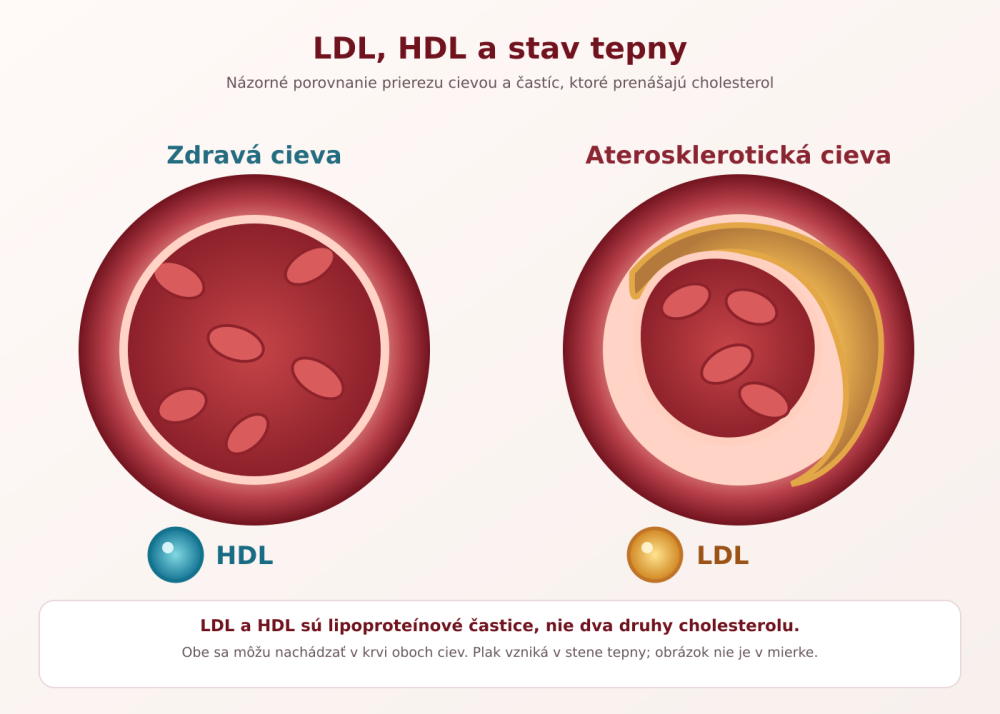
LDL and HDL are carriers, rather than two types of cholesterol. LDL particles have a causal role in atherosclerosis, and higher LDL-C increases risk; a higher HDL-C value alone does not cancel that risk. Lipid profile results are therefore assessed alongside other risk factors.
Lowering elevated LDL-C is a major treatment goal in the prevention of atherosclerotic cardiovascular disease.
A different group of lipoproteins. A high HDL-C value alone does not automatically mean low overall risk.
04 · LDL-C, non-HDL cholesterol and apoB
LDL-C indicates the amount of cholesterol carried by LDL particles. Non-HDL cholesterol includes cholesterol in all atherogenic lipoproteins. ApoB is a structural protein of atherogenic particles and can help estimate their number.
In some people, the amount of cholesterol carried and the number of atherogenic particles may differ. A doctor therefore interprets results in the context of overall risk.
Non-HDL cholesterol is calculated as total cholesterol minus HDL-C, with both values expressed in the same units. Measuring apoB provides additional information about particle numbers, which may differ from the amount of cholesterol they carry.
A laboratory reference range is not automatically your personal treatment target. The LDL-C target depends on overall risk and existing disease.
05 · HDL and triglycerides
Triglycerides are another type of fat in blood, and elevated levels may form part of a metabolic risk profile. HDL-C is often called “good cholesterol”, but this simplification has limitations. Cardiovascular risk cannot be assessed from one number alone.
The whole profile matters: LDL-C, non-HDL-C, triglycerides and, where relevant, apoB and Lp(a), as well as blood pressure, blood glucose, smoking, age, family history and existing disease.
06 · Lipoprotein(a) – Lp(a)
Lp(a) is a lipoprotein particle whose level is largely genetically determined. Current European guidelines use it as a factor that can refine cardiovascular risk estimates.
Lp(a) results are interpreted alongside other findings, particularly the overall risk profile and family history.
07 · What increases the risk of atherosclerosis?
An important modifiable cardiovascular risk factor.
Persistently elevated blood pressure increases cardiovascular risk.
Metabolic health is closely linked to vascular health.
LDL-C and other apoB-containing particles are key components of the atherosclerotic process.
Some risk factors cannot be changed but can be considered in prevention.
They influence several metabolic risk factors at once.
For more about related risk factors, see Blood pressure and Blood glucose and insulin.
08 · Which tests are used?
Depending on age, family history and overall risk, a doctor may assess the lipid profile, blood pressure, blood glucose or HbA1c, kidney function and other parameters. ApoB or Lp(a) may be added in some situations.
Imaging is not used in the same way for everyone. In selected people, findings of subclinical atherosclerosis or coronary artery calcium can help refine risk assessment and treatment decisions.
The meaning of a number depends on a person's overall cardiovascular risk.
A microscope image of a fresh drop of blood does not measure LDL-C, apoB or Lp(a), or confirm plaque in an artery. Blood lipids are assessed by laboratory testing; imaging arteries is a separate method.
For the differences between tests, see Heart, blood vessel and blood measurements.
09 · What can lifestyle changes influence?
Preventing atherosclerotic cardiovascular disease depends on a set of lasting habits, rather than a single food or supplement.
WHO identifies an unhealthy diet, physical inactivity, tobacco and harmful alcohol use as major modifiable cardiovascular risk factors. Their consequences can include raised blood pressure, blood glucose, blood lipids and obesity.
When choosing foods, the quality of fats and sources of fibre, such as vegetables, pulses and whole grains, also matter. For how this relates to nutrient transport, see Diet, blood and the brain.
10 · When is lifestyle alone not enough?
The need for treatment is not determined by one cholesterol value alone. A doctor considers overall cardiovascular risk, existing atherosclerotic disease, diabetes, kidney function, age, other risk factors and achieved lipid levels.
Medicines used to lower LDL-C include statins and, depending on the individual situation, other treatment options. Current ESC/EAS guidelines emphasise treatment according to overall risk and LDL-C targets.
Discuss side effects or questions about medicines with your doctor. Treatment can be adjusted in different ways according to the individual situation.
11 · When should you seek emergency help?
Atherosclerosis may remain symptom-free for a long time. Sudden chest pain or pressure, marked breathlessness, sudden weakness on one side of the body, speech problems, facial drooping, sudden vision changes or other acute neurological symptoms require emergency medical help.
Call your local emergency number immediately. In the EU, call 112.
12 · Frequently asked questions
Is cholesterol bad?
No. The body needs cholesterol. In atherosclerosis, the lipoprotein particles carrying it, their concentration and overall cardiovascular risk matter.
Is LDL the same as cholesterol?
Not exactly. LDL is a lipoprotein particle; LDL-C indicates the amount of cholesterol carried by LDL particles.
Is a high HDL level enough?
No. HDL-C is only one part of the lipid profile and does not itself remove the risk associated with high LDL-C, smoking, hypertension, diabetes or other factors.
What is apoB?
ApoB is a protein present on atherogenic lipoprotein particles. Measuring it can help refine estimates of particle numbers in some situations.
What is Lp(a)?
Lipoprotein(a) is a largely genetically determined risk factor. Elevated levels can change the overall cardiovascular risk estimate.
Can I stop cholesterol medication if I change my diet?
Do not change or stop prescribed treatment without consulting your doctor. The need for treatment depends on overall risk and health status.
Is arterial plaque the same as a blood clot?
No. Plaque forms in the artery wall. A clot results from blood coagulation and can form on a disrupted plaque surface. It can then suddenly restrict blood flow.
Can atherosclerosis develop without symptoms?
Yes. It can develop for a long time without noticeable symptoms. Having no symptoms does not by itself rule out risk; assessment also considers tests and personal or family history.
📚 Sources and scientific literature
- [1] ESC/EAS (2025): updated dyslipidaemia guidelines — LDL-C, risk and Lp(a)
- [2] ESC (2024): guidelines for elevated blood pressure and hypertension
- [3] WHO (2025): cardiovascular diseases, risk factors and warning signs
- [4] WHO (2026): principles of a healthy diet
- [5] NHLBI: atherosclerosis, plaque in the artery wall and possible complications
- [6] EAS (2020): the causal role of LDL in atherosclerosis — mechanisms and scientific evidence
- [7] ESC/EAS (2019): core dyslipidaemia guidelines — lipid profile, apoB and non-HDL cholesterol
Educational information: This article does not replace individual medical assessment, diagnosis or treatment. Discuss new symptoms and unusual results with your doctor. Do not change or stop prescribed treatment based on this article.