

 Slovensky (EUR)
 Česky (CZK)
 Magyar (HUF)
 Slovenščina (EUR)
 Deutsch (EUR)
What Is Collagen and What Role Does It Play in the Body?

KINGRAY ACADEMY · COLLAGEN · 01
What is collagen and what role does it play in the body?
Collagen is a structural protein that provides support for skin, bones, cartilage, tendons and ligaments. The body makes its own collagen from amino acids; vitamin C is also needed during this process.
01What is collagen?
Collagen is a structural protein that helps provide firm support for tissues. It is a natural part of the human body. The term collagen refers to a family of related proteins found in different proportions across different tissues.
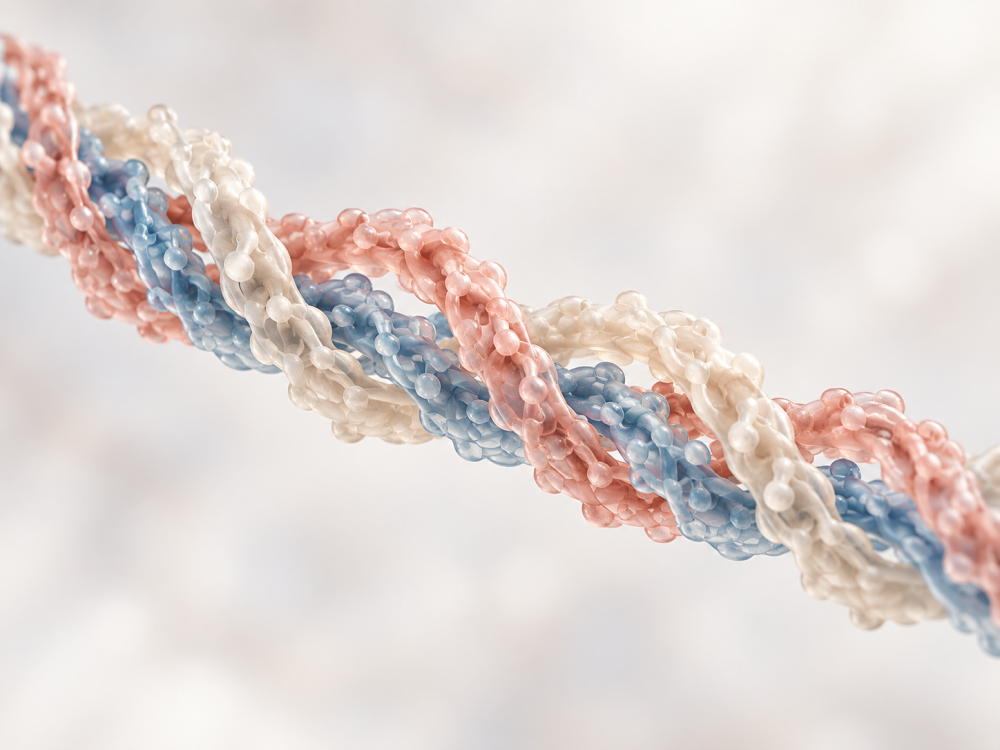
Its molecules have a characteristic triple-helix structure. In simple terms, imagine three strands wound around one another. This arrangement is closely related to collagen’s mechanical properties. [1]
02Where is collagen found?
Collagen is found in several tissues. The table below outlines its basic role in each of them. [1]
| Tissue | Basic role of collagen |
|---|---|
| Skin | Provides structural support and contributes to tissue strength. |
| Tendons and ligaments | Helps tissues withstand pulling forces and mechanical loading. |
| Bones | Forms the protein framework in which minerals are deposited. |
| Cartilage | Forms part of a network that, together with other components, determines the mechanical properties of cartilage. |
A more detailed overview of types I, II and III is provided in the next article: Types of collagen →
↑ Article contents03How does the body make collagen?
Collagen is produced by the body’s cells. In connective tissues, fibroblasts are one example of cells that perform this role. They use amino acids to build collagen, which is particularly rich in glycine and proline.
The process involves several steps: protein chains are produced, then modified and assembled into structures. Vitamin C is required for some of these modifications. [1]
↑ Article contents04Nutrition and vitamin C
Collagen production depends on the availability of building blocks and essential nutrients. Dietary protein supplies amino acids, while vitamin C plays a role in collagen synthesis itself. [1]
The human body cannot make vitamin C, so it must obtain it from outside sources. Foods containing vitamin C include peppers, kiwi fruit, citrus fruits, strawberries and broccoli. Eating a variety of fruit and vegetables helps provide this nutrient. [2]
For a related overview, read Vitamins for skin: C, A, E and omega-3.
05Questions and answers
Is collagen a protein?
Yes. It is a structural protein found in connective tissues. Read more in What is collagen?
Is collagen found only in the skin?
No. It is also found in bones, cartilage, tendons and other tissues. See the overview of where collagen is found.
Does the body make its own collagen?
Yes. The body’s cells produce collagen. The process is briefly explained in How does the body make collagen?
Is collagen the same as elastin or hyaluronic acid?
No. These are different substances. Collagen is a protein that provides structural support for tissues. The differences are explained in What is elastin? and What is hyaluronic acid?
Where can I compare collagen supplements?
Visit Choose collagen based on its ingredients. For a selection guide with expandable boxes, open the interactive collagen guide.
06Where can you find clinical studies?
This article explains the basic biology of collagen. Discussions of individual clinical studies are organised into separate articles according to the type of collagen and the research question.
Marine collagen · skin research
Research relating to collagen and skin, assessment methods and the limitations of the available evidence are discussed in Collagen and skin →.
Bovine collagen · skin and joints
A separate discussion of two clinical studies involving a specific bovine collagen peptide is available in Bovine collagen: two clinical studies →. When reading research, it is important to distinguish the ingredient studied from a finished food supplement.
Collagen · joints and movement
Research on joints is discussed separately from skin research, as the questions and outcomes differ. Continue to Collagen and the musculoskeletal system →.
07Sources
[1] NCBI Bookshelf / StatPearls: Biochemistry, Collagen Synthesis
[2] NIH Office of Dietary Supplements: Vitamin C – Health Professional Fact Sheet
Sources for individual collagen studies and discussions of their limitations belong to the relevant articles linked in the previous chapter.
This text is intended for general education and does not replace individual advice from a healthcare professional.
↑ Article contents