

 Slovensky (EUR)
 Česky (CZK)
 Magyar (HUF)


Collagen for Skin: Types & Product Comparison | Kingray
Collagen for skin: Which type to choose and how to combine it with skincare
Does your skin feel drier, less elastic or show its first fine lines? Youthful-looking skin is not the result of one miracle product. External protection, suitable skincare and an adequate intake of nutrients all play a role.
What is useful to know from the start?
Products designed with skin in mind most commonly contain collagen types I and III.
Collagen is broken down into smaller peptides, which are then processed in the digestive tract.
Daily protection from UV radiation remains a key part of anti-ageing skincare.
Why does skin lose collagen?
Collagen forms a firm supporting structure in the skin. Elastin contributes to elasticity, while hyaluronic acid naturally binds water. The skin’s structure and renewal gradually change with age.
- excessive UV exposure,
- smoking,
- excessive alcohol consumption,
- an unbalanced diet,
- lack of sleep,
- chronic stress,
- unsuitable or overly aggressive skincare.
It therefore makes sense not only to consider nutrient intake, but above all to protect the skin structures already present. Suitable broad-spectrum UV protection is important when spending time in the sun.
Which type of collagen is most relevant for skin?
The most abundant type
Type I collagen is found in large amounts in the skin, as well as in bones, tendons and connective tissue.
Often found together with type I
Type III is found alongside type I in the skin and other soft tissues.
Mainly cartilage
Type II is mainly associated with cartilage, which is why it is more commonly used in joint supplements.
Fish or bovine collagen?
Your choice should not be based only on the words “fish” or “bovine”. Consider the collagen type, the amount of hydrolysed collagen peptides per daily serving, the overall formula and regular use.
The Swedish Collagen products below use hydrolysed marine or fish collagen, mainly types I and III. They are not suitable for people with a fish allergy.
It may be an alternative for those who do not wish to use fish collagen. The specific type and daily amount should still be checked.
Why hydrolysed collagen?
A collagen molecule is large. Hydrolysis breaks it down into smaller collagen peptides, which then pass through the digestive process.
Consumed collagen does not travel directly to a wrinkle as a ready-made filler. The digestive system processes it, and the body uses the resulting amino acids and peptides according to its needs.
Vitamin C contributes to normal collagen formation for the normal function of skin. This is why it is included in several comprehensive collagen formulas.
Which Swedish Collagen should you choose?
Not all collagen products have the same formula. Some focus mainly on a high collagen amount, while others add hyaluronic acid, elastin, MSM, vitamins, minerals, probiotics or botanical extracts.
It is therefore better to choose according to your goal and the formula rather than the product name alone.
Swedish Collagen Deluxe 12,500 mg
The daily serving contains 12,500 mg of hydrolysed fish collagen types I and III a 75 mg of hyaluronic acid. The formula also contains 120 mg of vitamin C, MSM, silicon, zinc, selenium, biotin, vitamins B5, B6 and B12, and vitamin D3.
A suitable option for someone looking for more than collagen alone and preferring a broader formula in one daily serving.
View Swedish Collagen Deluxe 12,500 mg →Swedish Gold Collagen 15,000 mg
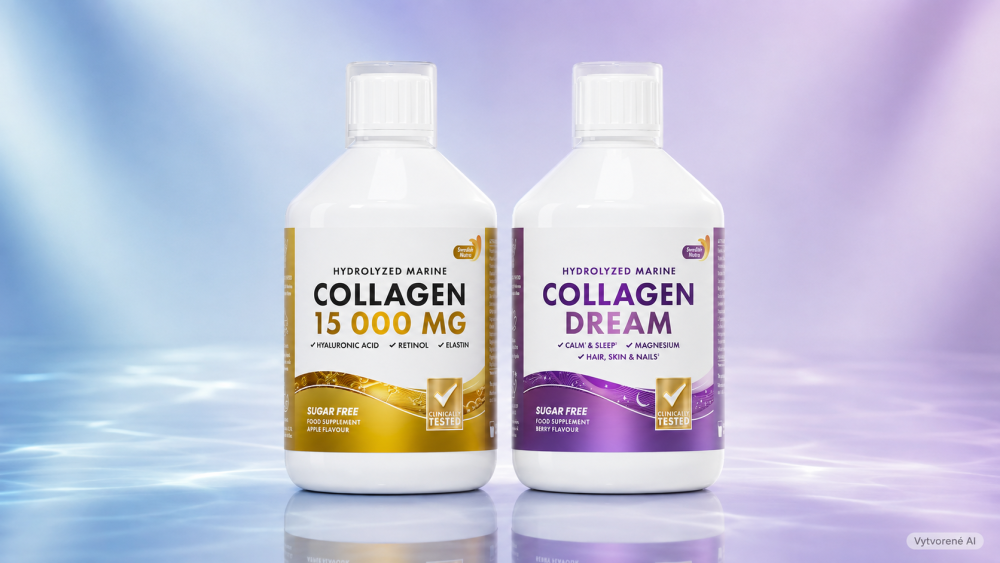
One daily serving contains 15,000 mg of hydrolysed marine collagen types I and III, 200 mg of MSM, 50 mg of hyaluronic acid, 10 mg of elastin and 2 mg of astaxanthin.
Its vitamins and minerals include vitamin C, vitamin A, vitamin D3, biotin, zinc, selenium and vitamin K2.
Swedish Collagen MAX 15,000 mg
MAX contains 15,000 mg of hydrolysed marine collagen types I and III. Among the products featured in this article, it also has the highest amount of hyaluronic acid – 150 mg per daily serving.
The formula also contains 50 mg of elastin, 125 mg of MSM, vitamin C, vitamin D3, B vitamins, biotin, zinc and selenium.
It may suit those who prioritise a high collagen amount and a comprehensive formula with hyaluronic acid and elastin.
View Swedish Collagen MAX 15,000 mg →Swedish Nutra Marine Beauty 10,000 mg – 20 shots
Each 25 ml shot contains 10,000 mg of hydrolysed fish collagen types I and III and 100 mg of hyaluronic acid.
The formula is complemented by 50 mg of silicon, vitamin C, vitamins B5, B6, B7 and B12, vitamin D3, zinc and selenium.
Single-serving packaging is especially convenient for travel or for anyone who does not want to measure a serving from a bottle each day.
View Marine Beauty 10,000 mg shots →Swedish Collagen Hair
This formula contains 2,500 mg of hydrolysed marine collagen per daily serving. Its collagen amount is therefore lower than in products with 10,000–15,000 mg, but the overall formula is considerably broader.
It contains, for example, 1,000 mg of inositol, 500 mg of MSM, 100 mg of hyaluronic acid, coenzyme Q10, vitamins A, C and E, B vitamins, 5,000 μg of biotin, zinc, copper, selenium and botanical extracts.
The product also contains green tea extract and a small amount of caffeine.
View Swedish Collagen Hair →Swedish Collagen DREAM 10,000 mg
DREAM contains 10,000 mg of hydrolysed marine collagen types I and III and 50 mg of hyaluronic acid.
The formula also contains 150 mg of magnesium, 500 mg of L-tryptophan, 200 mg of L-theanine and botanicals such as valerian, lavender, hops, ashwagandha and passionflower.
It therefore follows a different concept from classic beauty collagens: collagen is combined with ingredients typically found in comprehensive evening formulas.
View Swedish Collagen DREAM →Swedish Collagen Morning Glow 10,000 mg
Morning Glow contains 10,000 mg of hydrolysed marine collagen types I and III, 25 mg of hyaluronic acid, 100 mg of MSM and a microencapsulated probiotic complex providing 1 billion CFU per daily serving.
The formula also includes 200 mg of choline, 100 mg of resveratrol, vitamins A, C, B2, B3, B5 and B6, biotin, B12, vitamin D3 and selenium.
Quick guide: which product for whom?
| Product | Collagen | Hyaluronic acid | Key features |
|---|---|---|---|
| Deluxe | 12,500 mg | 75 mg | MSM, silicon, vitamins and minerals |
| Gold | 15,000 mg | 50 mg | elastin, astaxantin, K2 |
| MAX | 15,000 mg | 150 mg | 50 mg elastin, MSM |
| Marine Beauty | 10,000 mg | 100 mg | convenient single-serving shots |
| Hair | 2,500 mg | 100 mg | biotin, inositol, MSM, Q10 |
| DREAM | 10,000 mg | 50 mg | magnesium, L-theanine, L-tryptophan and botanicals |
| Morning Glow | 10,000 mg | 25 mg | probiotics, choline, resveratrol, caffeine |
How long should collagen be taken?
Clinical studies do not assess collagen supplements after only a few days, but during regular use over a longer period. Studies evaluating skin-related parameters often use periods of approximately 8 to 12 weeks.
- follow the serving instructions for the specific product,
- use it regularly,
- do not exceed the recommended daily serving,
- do not combine full daily servings of several complex products without professional advice,
- also consider your overall diet and intake of protein and vitamin C.
What does collagen do in cosmetics?
A collagen supplement and a cosmetic product do not work in the same way. A food supplement passes through the digestive tract, while a cosmetic product acts mainly on the skin’s surface and barrier.
Large collagen molecules in a cream should not be viewed as a filler that simply penetrates deep skin layers and replaces the skin’s own collagen. Skincare can nevertheless support hydration, comfort and the skin barrier.
Retinol, hyaluronic acid and daily skincare
Anti-ageing skincare commonly includes ingredients such as retinol, niacinamide, hyaluronic acid, glycerin, vitamin E and plant oils.
Gentle cleansing → hydrating care → day cream → suitable UV protection as the final step.
Gentle cleansing → serum as needed → night cream. Introduce retinol gradually and increase frequency according to tolerance.
A combined inside-and-out approach makes the most sense
A varied diet, adequate protein and vitamin C, plus a hydrolysed collagen supplement if individually chosen.
Gentle cleansing, hydration, suitable active ingredients, protection of the skin barrier and, above all, UV protection.
A collagen supplement does not replace skincare, and skincare does not replace a varied diet. These are different parts of care and should be considered separately.
Frequently asked questions
Not necessarily. Consider the complete formula, daily serving, consistency of use and individual needs.
For most collagen products, the exact time is not decisive. Regular use according to the manufacturer’s directions is more important. Specific formulas can be an exception—for example, Morning Glow contains caffeine.
Do not automatically combine full daily servings of several complex products, as this may unnecessarily multiply the amounts of vitamins, minerals and other ingredients.
Products containing fish or marine collagen are not suitable for people with a fish allergy. A different suitable form should be selected.
Conclusion
When choosing collagen for skin, there is no need to search for one universally “best” product. What matters is understanding what you expect from it and what the formula actually contains.
Those looking for the highest collagen amount can compare Gold and MAX, both with 15,000 mg. Those who prefer convenient single servings may choose Marine Beauty. Hair, DREAM and Morning Glow have more specialised formulas in which collagen is only one part of the overall complex.
Youthful-looking skin is not created by one intervention. A sensible foundation includes UV protection, suitable skincare, a varied diet, adequate protein and long-term consistency.
Related information and product selection
- American Academy of Dermatology – ageing skin care and retinoids
- published systematic reviews and clinical studies of oral collagen peptides
- product labels and current Swedish Nutra / Swedish Collagen product information on Kingray.eu