

 Slovensky (EUR)
 Česky (CZK)
 Magyar (HUF)


Collagen: What Types Are There and How to Choose Between Marine and Bovine Collagen?
Collagen is a naturally occurring protein and one of the main structural proteins in the human body. It is found in connective tissues such as skin, bones, cartilage and tendons.
When choosing a collagen food supplement, you may come across terms such as hydrolysed collagen, collagen peptides, marine collagen, fish collagen, bovine collagen and collagen types I, II or III.
What do these terms mean?
What is the difference between marine and bovine collagen?
Does vegan collagen exist?
And what happens to collagen in the digestive tract after you take it?
Let us look at the differences.
What is hydrolysed collagen?
Many food supplements contain hydrolysed collagen, also known as collagen peptides.
Hydrolysis is a process that breaks large collagen molecules down into smaller peptides. Hydrolysed collagen is used in products such as liquid and powdered food supplements.
When comparing products, look beyond the name of the collagen and consider:
- the source of the collagen,
- its form,
- the amount of collagen in the recommended daily serving,
- the other ingredients in the product.
What types of collagen are there?
Several types of collagen have been identified in the human body. Some of the best known are collagen types I, II and III.
Type I collagen
Type I collagen is the most abundant type of collagen in the human body. It is found in tissues such as skin, bones and tendons.
Type II collagen
Type II collagen is a characteristic component of cartilage.
Type III collagen
Type III collagen is often found alongside type I collagen in various connective tissues.
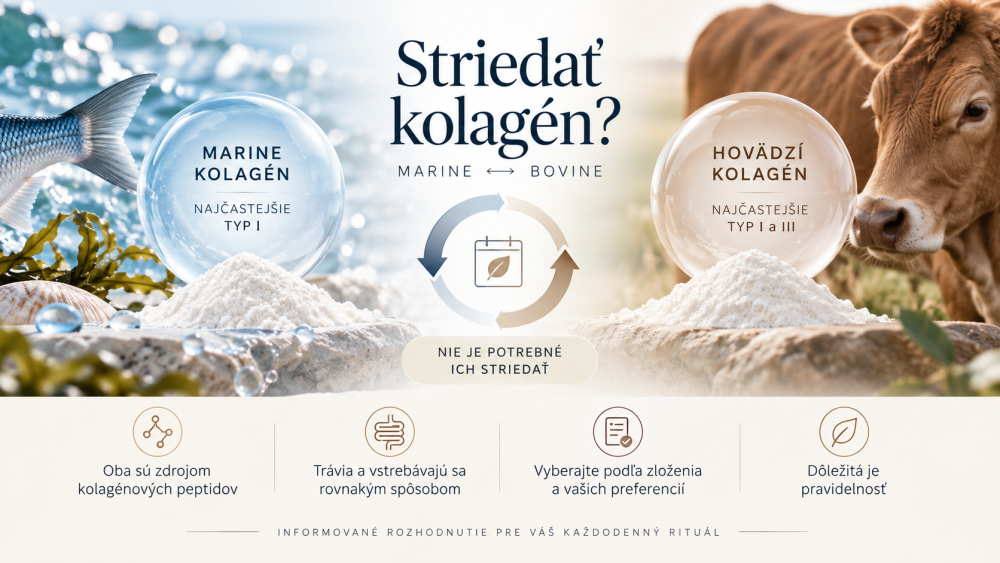
It is important to distinguish between collagen type and collagen source. The terms marine, fish and bovine collagen mainly describe the source of the raw material.
What is bovine collagen?
Bovine collagen is obtained from cattle tissues. It commonly contains mainly types I and III collagen.
In food supplements, it may be used in the form of hydrolysed collagen peptides.
When choosing a product, check its overall composition and the amount of collagen in the recommended daily serving.
A bovine source alone does not make a product automatically “stronger” or “more effective” than a product containing marine collagen.
Marine collagen explained
Marine collagen, often labelled as marine collagen, comes from marine sources. Fish collagen is obtained from fish-derived raw materials.
Hydrolysed fish collagen is often used in food supplements, with type I collagen typically predominating.
Marine or fish collagen may be an option for people who prefer a fish source to a bovine source for personal or dietary reasons.
For products containing fish, pay attention to the allergen information on the label of the specific product.
It is not appropriate to assume that marine collagen is “better” or “more effective” than bovine collagen. Compare the composition of the individual products.
Marine or bovine collagen – what is the difference?
The main difference between marine and bovine collagen lies in the source of the raw material and the collagen types typically present.
On mobile, swipe the table sideways →
| Comparison | Bovine collagen | Marine / fish collagen |
|---|---|---|
| Source | cattle-derived raw material | marine / fish-derived raw material |
| Typical collagen types | mainly types I and III | predominantly type I |
| Hydrolysed form | yes, depending on the product | yes, depending on the product |
| Collagen peptides | depending on the raw material used | depending on the raw material used |
| Allergens | depending on the individual product | fish collagen contains the fish allergen |
When choosing, consider the source and form of collagen, the amount in the recommended daily serving, the full ingredient list, vitamins and minerals, and allergen information.
Both marine and bovine hydrolysed collagen pass through the digestive tract after consumption. Amino acids and some small peptides are absorbed mainly in the small intestine. Their specific composition can vary depending on the collagen source and processing method.
Does vegan collagen exist?
It is important to distinguish between collagen itself and products intended for vegans.
Conventional natural collagen is an animal protein. Collagen obtained from cattle or fish is therefore not vegan.
Products may be marketed using terms such as “vegan collagen” or “vegan collagen support”. These products can have different compositions and may contain vitamins, minerals, amino acids or plant ingredients.
Always check the actual composition of the product. A product labelled “vegan collagen support” should not automatically be equated with conventional hydrolysed collagen of animal origin.
A vegan alternative from Swedish Nutra
Swedish Nutra also offers a vegan alternative for people who do not wish to take collagen of animal origin. Swedish Nutra Vegan Collagen Booster 10,000 mg is intended for vegans and offers an option for those who want to avoid bovine or fish sources.
For vegan products, distinguish between conventional collagen and a blend of plant-derived or non-animal ingredients. Conventional natural collagen is an animal protein, so vegan alternatives differ in composition from bovine and marine collagen.
The main distinguishing feature of a vegan alternative is its non-animal origin and suitability for a vegan diet. As with other food supplements, check the specific ingredients, recommended daily serving and declared quantities.
Alongside its vegan blend, Swedish Nutra Vegan Collagen Booster contains hyaluronic acid and vitamins, so compare the full composition with marine or bovine collagen products, rather than focusing only on the word “vegan”.
How is animal-derived collagen absorbed and what happens after you drink it?
Collagen consumed in food or a supplement does not enter the skin, bones or cartilage in an unchanged form.
Collagen is a protein. In the digestive tract, proteins are digested into smaller peptides and amino acids.
With hydrolysed collagen , the large collagen molecules have already been broken down into smaller collagen peptides by hydrolysis during manufacture.
Where is collagen absorbed?
The main site of nutrient absorption is the small intestine.
After digestion, amino acids and some small peptides are absorbed through the intestinal wall and enter the bloodstream. The circulation transports absorbed nutrients around the body.
The idea that the collagen you drink travels unchanged “directly” to the skin, bones or joints is therefore inaccurate. The body processes the absorbed nutrients and uses them according to its physiological needs.
Where are vitamins absorbed?
Vitamins in food supplements also pass through the digestive system before being absorbed.
Much of nutrient absorption takes place in the small intestine, although the exact site and mechanism of absorption vary between vitamins and other substances.
Water-soluble vitamins, including vitamin C and B vitamins, have different absorption and transport mechanisms from fat-soluble vitamins A, D, E and K.
What does the large intestine do?
The large intestine is not the main site of absorption for amino acids and collagen peptides.
Its important functions include absorbing water and electrolytes. It also hosts a large community of gut microorganisms.
For the absorption of amino acids and small peptides produced during protein digestion, the key site is the small intestine.
Collagen and vitamin C – why are they often combined?
Vitamin C has a specific role in collagen formation. The European Union has authorised health claims for vitamin C that may be used when the applicable conditions are met.
Vitamin C contributes to normal collagen formation for the normal function of skin.
Vitamin C also contributes to normal collagen formation for the normal function of:
- bones,
- cartilage,
- blood vessels,
- gums,
- teeth.
When comparing collagen food supplements, check whether they contain vitamin C and in what amount.
How do you choose collagen?
There is no simple rule that makes one collagen source automatically the best choice for everyone.
When comparing collagen food supplements, look at:
- the source of collagen – for example, bovine or fish,
- the form of collagen – for example, hydrolysed collagen / collagen peptides,
- the amount of collagen in the recommended daily serving,
- the full ingredient list,
- the vitamin and mineral content,
- other declared ingredients,
- allergens,
- the recommended daily serving.
The declared collagen quantity allows you to compare the composition of different products objectively.
Swedish Nutra – how do you navigate the liquid collagen range?
Swedish Nutra liquid collagen food supplements include different formulas that vary in their collagen source and quantity, vitamin content and other declared ingredients.
You do not need to look for a universally “best collagen”. Compare the specific composition of each product and choose according to your preferences.
Swedish Nutra Gold, Deluxe, Vegan or MAX – what is the difference?
Products can be compared using the objective information provided in their composition details.
Swedish Nutra and Swedish Collagen formulas differ in the amount of collagen or vegan blend, hyaluronic acid and other ingredients. Compare the full composition and the quantities of individual substances in the recommended daily serving.
On mobile, swipe the table sideways →
| Ingredient per 25 ml daily serving | GOLD15,000 mg | DELUXE12,500 mg | MAX15,000 mg | VEGAN BOOSTER10,000 mg |
|---|---|---|---|---|
| Format | liquid | liquid | liquid | liquid |
| Source | fish / marine | fish / marine | fish / marine | vegan blend |
| Collagen type | I and III | I and III | I and III | not conventional animal-derived collagen |
| Collagen / vegan blend | 15,000 mg | 12,500 mg | 15,000 mg | 10,000 mg |
| Hyaluronic acid | 50 mg | 75 mg | 150 mg | 50 mg |
| MSM | 200 mg | 125 mg | 125 mg | 125 mg |
| Elastin | 10 mg | – | 50 mg | – |
| Vitamin C | 120 mg | 120 mg | 120 mg | 50 mg |
| Vitamin A | 800 μg | – | – | – |
| Vitamin B5 | 12 mg | 50 mg | 50 mg | 50 mg |
| Vitamin B6 | – | 1.4 mg | 1.4 mg | 1.4 mg |
| Biotin (B7) | 450 μg | 5,000 μg | 5,000 μg | 5,000 μg |
| Vitamin B12 | – | 7.5 μg | 7.5 μg | 7.5 μg |
| Vitamin D3 | 35 μg | 30 μg | 25 μg | 30 μg |
| Vitamin K2 | 75 μg | – | – | – |
| Zinc | 10 mg | 10 mg | 10 mg | 10 mg |
| Selenium | 27.5 μg | 55 μg | 55 μg | 55 μg |
| Silicon | – | 25 mg | – | 25 mg |
| Detox Skin Cleanse / extract | – | 100 mg | 100 mg | 100 mg |
| Astaxanthin | 2 mg | – | listed in the ingredients | – |
How do the formulas differ?
Swedish Collagen GOLD 15,000 mg contains 15,000 mg of hydrolysed marine collagen types I and III per daily serving. The formula includes 50 mg of hyaluronic acid and 200 mg of MSM. Features that distinguish it from the other formulas compared here include vitamin A, vitamin K2, astaxanthin and organic raspberry, blueberry and beetroot powders.
Swedish Collagen DELUXE 12,500 mg contains 12,500 mg of hydrolysed fish collagen types I and III and 75 mg of hyaluronic acid. The formula also includes MSM, silicon, vitamins C, B5, B6, biotin, B12 and D3, zinc, selenium and a blend of green tea extract, aloe vera and citrus bioflavonoids.
Swedish Collagen MAX 15,000 mg contains 15,000 mg of hydrolysed marine collagen types I and III. Among these three fish collagen formulas, it has the highest declared hyaluronic acid content – 150 mg per daily serving – alongside 50 mg of elastin, 125 mg of MSM, vitamins and minerals.
Swedish Nutra Vegan Booster 10,000 mg is an alternative for people who do not wish to take animal-derived collagen. It contains 10,000 mg of a vegan blend, 50 mg of hyaluronic acid, MSM, silicon, vitamins C, B5, B6, biotin, B12 and D3, zinc, selenium and plant extracts. This blend should be distinguished from conventional collagen of animal origin.
Why compare Swedish Nutra collagen products by composition?
The clearest way to compare food supplements is to examine specific, measurable information.
For Swedish Nutra products, you can compare:
- the amount of collagen in the recommended daily serving,
- the source of the collagen,
- the hydrolysed form,
- vitamin content,
- hyaluronic acid and other declared ingredients,
- the recommended daily serving.
This approach helps you choose by actual composition. Differences in ingredient quantities do not, by themselves, demonstrate differences in health outcomes.
Would you like to explore the full range?
Explore Swedish Nutra and Swedish Collagen – marine and bovine collagen, joint nutrition and vegan alternatives in different formats and formulas.
Browse the Swedish Nutra collagen range →Frequently asked questions about collagen
Select a question to reveal the answer.