

 Slovensky (EUR)
 Česky (CZK)
 Magyar (HUF)
 Slovenščina (EUR)
 Deutsch (EUR)


06. Senescent Cells and Senolytics: What Science Is Exploring About Cellular Ageing


Senescent cells and senolytics: what science is exploring about cellular ageing
Senescent cells are living cells that have stopped dividing, for example because of DNA damage or prolonged cellular stress. Their development is part of the body's protective mechanisms, and they can also help with healing. However, when they accumulate and persist in tissues, they can release substances that promote chronic inflammation and impair the surrounding tissue's function. Scientists therefore study their role in ageing and age-related diseases. Senolytics are substances being investigated for their ability to selectively remove certain senescent cells. The aim is to support healthy ageing and preserve the body's ability to function.
Sources for the introduction: [1] [2] [3] [4] [5] [6] [7]
What are senescent cells?
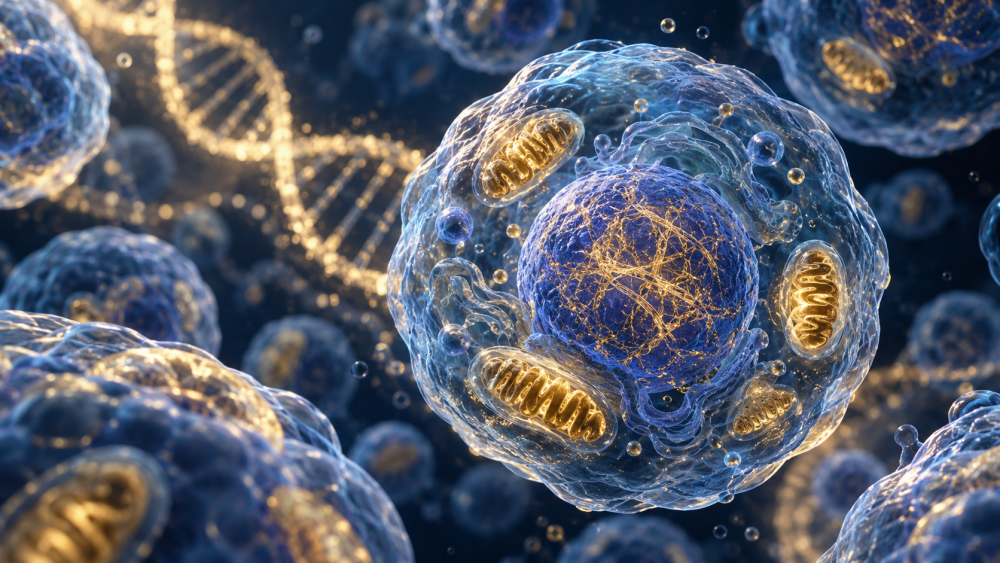
Cellular senescence is a state involving a lasting halt to cell division and other changes in cellular activity. A senescent cell remains alive and metabolically active even though it has stopped dividing. Chemical processes continue inside it. The term does not simply mean a cell that is chronologically “old”. [1]
Many senescent cells release a mixture of signalling substances called the SASP — senescence-associated secretory phenotype. In everyday terms, these are substances through which the cell influences its surroundings. They can affect the inflammatory environment and neighbouring cells. Their composition and effects vary with the circumstances. [2]
| Term | Meaning |
|---|---|
| Senescence | A cellular state with arrested division and altered characteristics. |
| SASP | A collection of substances released by many senescent cells. |
| Senolytics | Substances studied for their ability to selectively eliminate senescent cells. |
“Zombie cells” is a popular metaphor, not a precise scientific definition.
Why is senescence not only a problem?
Senescent cells can play useful roles, including helping repair tissues. It is important to distinguish a temporary response from the long-term accumulation of cells or their signals. [2]
In a 2014 mouse experiment, senescent cells supported wound healing through PDGF-AA, a signalling substance that helps regulate tissue repair. Removing these cells slowed healing. [3]
What are scientists investigating with senolytics?
Senolytics are being studied as a way to disrupt the survival mechanisms of certain senescent cells and allow their removal. Frequently discussed examples include dasatinib combined with quercetin and fisetin. These substances are not interchangeable, nor do they have a universal effect across all cell types. [4] [5]
A clinical trial involving two substances in combination does not prove that quercetin alone produces the same result. Similarly, a property observed in cell culture does not establish the effectiveness of an ordinary supplement in humans.
Research protocols are not instructions for experimenting at home. Dasatinib is a medicine; senolytic interventions require safety assessment and clinical supervision. [2]
From mice to humans: four examples of research

Fisetin: longer lifespan in mice
A 2018 paper studied fisetin in cellular and animal models. In old mice, it reduced certain indicators of senescence and extended both median and maximum lifespan in the model studied. Here, the median is the age reached by half the animals being followed. Effects varied by cell type. [5]
This study did not demonstrate longer human life. It also included experiments with human tissue, but these are not the same as a clinical trial tracking health or survival in people.
Diabetic kidney disease: a small biomarker study
A small preliminary study in 2019 included 9 people with diabetic kidney disease. It was open-label, meaning that participants and researchers knew which substances were given. Following a short course of dasatinib with quercetin, researchers observed reductions in several indicators of senescence in fat tissue and skin. [4]
The finding supported further investigation of the combination's effects on tissues. The small sample, lack of a control group and short follow-up do not establish effective treatment of kidney disease or overall rejuvenation.
Pulmonary fibrosis: feasibility and functional tests
A 2019 open-label pilot study followed 14 patients with idiopathic pulmonary fibrosis, a disease involving lung tissue scarring without a known cause. Its main aim was to assess whether the proposed research procedure could be carried out. Some physical function tests improved after the intervention, but lung function did not change. Adverse events were also reported, including one serious event; reporting an event does not itself show that the intervention caused it. [6]
Without a control group, the effect of the intervention cannot reliably be separated from other influences. The study provided a basis for further testing, rather than confirmation of an effective treatment.
Postmenopausal women: no improvement in the primary outcome
A 2024 randomised phase 2 trial included 60 postmenopausal women, assigned to groups by chance. It investigated intermittent administration of dasatinib with quercetin and the processes of bone formation and breakdown. The main outcome — the change in the blood marker CTx, which is associated with bone breakdown — did not differ significantly between groups at 20 weeks. [7]
Earlier changes in a bone formation marker and additional analysis of a smaller subgroup generated ideas for further investigation. They do not replace the main finding, in which no significant difference was confirmed, or prove a general anti-ageing effect.
What does a change in a biomarker mean?
A biomarker is a measurable indicator of a biological process, such as a particular protein in the blood or a feature of a tissue sample. Senescence is identified through a combination of features. A single marker is not a universal counter of all senescent cells in the body. International expert consensus therefore emphasises the need for multiple indicators interpreted in the context of the tissue. [1]
| Observation | What it does not yet establish |
|---|---|
| A reduction in a marker in a tissue sample (biopsy) | Rejuvenation of the whole body. |
| Longer life in mice | Extension of human lifespan. |
| Improvement after an intervention without a control group | That the intervention itself caused the improvement. |
| A favourable subgroup finding | An effect in the whole population. |
What still needs to be established?
- How to accurately identify problematic senescent cells.
- Which groups of patients may benefit from an intervention.
- Whether biomarker changes translate into health outcomes.
- What the long-term effects and adverse consequences are.
Questions about longevity require long-term clinical outcomes. The human trials cited here did not demonstrate lifespan extension.
Conclusion: a promising research direction, not proven rejuvenation
Senescence has both useful and problematic roles. Assessing senolytics therefore requires attention to cell type, tissue, timing and safety. Findings in mice and biomarker changes in humans provide a basis for further research, rather than proof of longer human life.
When reviewing new studies, we will focus particularly on the primary outcome, control group, health benefits and adverse effects.
Frequently asked questions
Are senescent cells dead cells?
No. They remain alive and can release signalling substances even after they stop dividing.
Is senescence the same as autophagy?
No. Senescence describes a cellular state. Autophagy is the breakdown and recycling of cellular material. Read more in article 05 on autophagy.
Has fisetin been shown to rejuvenate humans?
The cited 2018 study does not provide such evidence. Its lifespan findings concerned mice.
Do findings for dasatinib with quercetin also apply to quercetin alone?
Not automatically. The combination and the individual substances require separate assessment.
Does this article recommend taking senolytics?
No. It describes research and does not provide a dosing protocol. Clinical trial findings are not instructions for self-treatment or a reason to change prescribed treatment.
Sources and further reading · 7 sources
- Gorgoulis et al. (2019): Cellular Senescence: Defining a Path Forward. Cell. Expert consensus and review. DOI: 10.1016/j.cell.2019.10.005.
- Chaib S., Tchkonia T., Kirkland J. L. (2022): Cellular senescence and senolytics: the path to the clinic. Nature Medicine. Expert review of biological mechanisms and clinical research. DOI: 10.1038/s41591-022-01923-y.
- Demaria et al. (2014): An essential role for senescent cells in optimal wound healing through secretion of PDGF-AA. Developmental Cell. Preclinical experiment. DOI: 10.1016/j.devcel.2014.11.012.
- Hickson L. J. et al. (2019): Senolytics decrease senescent cells in humans: Preliminary report from a clinical trial of Dasatinib plus Quercetin in individuals with diabetic kidney disease. EBioMedicine. Pilot study in diabetic kidney disease. DOI: 10.1016/j.ebiom.2019.08.069.
- Yousefzadeh et al. (2018): Fisetin is a senotherapeutic that extends health and lifespan. EBioMedicine. Preclinical research; lifespan findings in mice. DOI: 10.1016/j.ebiom.2018.09.015.
- Justice et al. (2019): Senolytics in idiopathic pulmonary fibrosis: Results from a first-in-human, open-label, pilot study. EBioMedicine. Open-label pilot study. DOI: 10.1016/j.ebiom.2018.12.052.
- Farr J. N. et al. (2024): Effects of intermittent senolytic therapy on bone metabolism in postmenopausal women: a phase 2 randomized controlled trial. Nature Medicine. Randomised phase 2 trial. DOI: 10.1038/s41591-024-03096-2.
Sources selected by the author, not a systematic review of all publications. This article is educational and does not replace diagnosis or individual medical advice.