

 Slovensky (EUR)
 Česky (CZK)
 Magyar (HUF)
 Slovenščina (EUR)
 Deutsch (EUR)


08. Epigenetic reprogramming: what we know about cell rejuvenation

Epigenetic reprogramming: what we know about cell rejuvenation
Can epigenetic reprogramming rejuvenate a person?
It has not yet been shown to safely rejuvenate a whole person. Partial reprogramming is being studied as a way to restore some features of younger cells while preserving their identity. Findings in cell cultures and mice provide a promising basis for further research; early testing in an eye condition has not yet established long-term benefit or extended human lifespan. [2] [3] [4] [5]
We explain epigenetics, Yamanaka factors and the difference between full and partial reprogramming. We compare three experimental papers with the preliminary ER-100 announcement and show why a lower molecular age in a cell is not the same as rejuvenating a person.
What is epigenetic cell reprogramming?
Epigenetic mechanisms help cells determine which genes are active and to what extent. These settings change during ageing. Partial epigenetic reprogramming aims to restore some properties of younger cells while preserving their original identity and function. In experiments on cells and animals, scientists have observed changes in molecular age markers and improvements in some cellular and tissue functions. This approach is therefore being investigated as a possible route to regeneration and healthy ageing. In optic nerve disorders, early clinical testing of the safety and tolerability of this intervention is already underway.
How does epigenetics relate to cell identity?
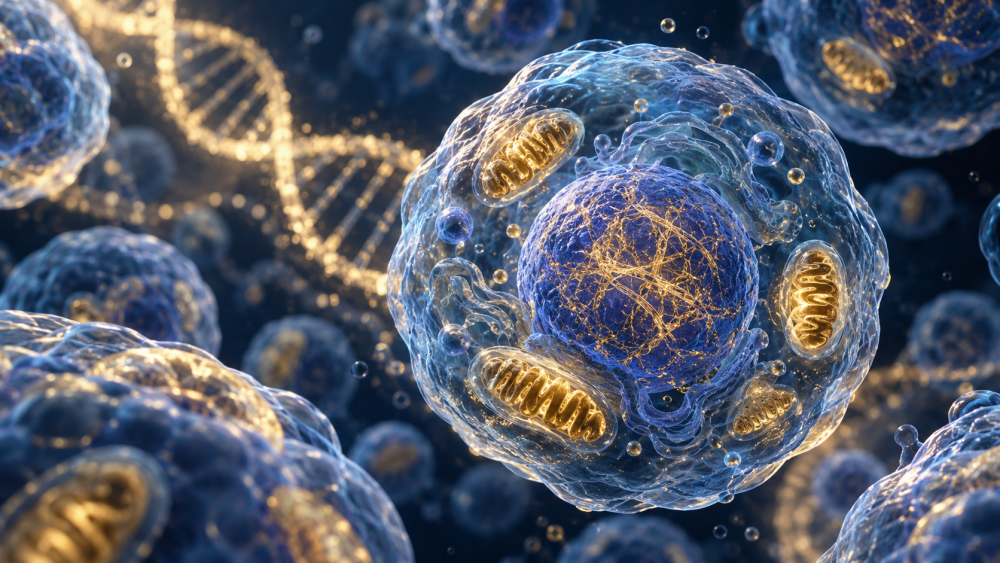
A specialised cell has its own way of using genetic information. Epigenetics also examines mechanisms that affect gene activity without changing the sequence of DNA letters itself. DNA methylation patterns are among the characteristics studied – the distribution of small chemical marks on DNA associated with gene regulation. [1]
Reprogramming has shown that cellular specialisation is not necessarily irreversible. Research awarded the Nobel Prize in 2012 laid the foundations for methods that can return mature cells to a pluripotent state: a state capable of generating different cell types. [1]
Yamanaka factors and partial reprogramming
Four regulatory factors are frequently mentioned: OCT4, SOX2, KLF4 and c-MYC, collectively known as OSKM. Some approaches use the OSK trio. These are not vitamins or ordinary food supplement ingredients, but experimental ways of influencing cellular programmes. [2] [3]
Full reprogramming changes a cell’s identity. Partial approaches aim to separate beneficial age-related changes from the permanent loss of its specialisation. The outcome depends on the specific method and cell type. [4]
What have cell reprogramming experiments shown?
| Research | Observation | Important limitation |
|---|---|---|
| Ocampo et al., 2016 [2] | Cyclic partial reprogramming improved selected hallmarks of ageing and extended lifespan in a mouse model of premature ageing. | A model of premature ageing does not represent normal human ageing. |
| Lu et al., 2020 [3] | OSK promoted nerve fibre regeneration and restored vision in the mouse models studied. | A finding in a mouse eye is not evidence of whole-body rejuvenation. |
| Gill et al., 2022 [4] | Transient reprogramming of human skin fibroblasts, cells that help build and maintain connective tissue, changed molecular age markers and some functional properties. | These were cells in culture, not rejuvenation of the people who donated them. |
What does “a cell decades younger” mean?
In the work by Gill and colleagues, some molecular age estimates were substantially lower after the intervention. However, the measurements concerned cultured cells. Such a number cannot be translated into the years by which a person became younger or the number of extra years of life. [4]
Is epigenetic reprogramming being tested in humans?
The ER-100 programme is bringing this approach into early clinical research in optic nerve disorders. On 8 October 2026, the sponsor, Life Biosciences, announced preliminary phase 1 data from three participants with open-angle glaucoma. According to its report, the intervention was well tolerated through day 56. [5]
This is an interim company announcement, not confirmation of efficacy in a large peer-reviewed study. The small number of participants and short follow-up do not establish long-term safety or clinical benefit. Testing in a specific eye disease also does not demonstrate slower overall ageing or longer life in healthy people.
Trial identifier: NCT07290244. The research status described in this article is tied to its update date.
What risks and limitations must research still address?
When intervening in cellular identity, tracking a single promising marker is not enough. We need to know whether proper tissue function is preserved and whether unwanted changes occur. Full and partial reprogramming must therefore not be confused. [1] [4]
- Precision: which cells the intervention affects and whether it also changes cells that should remain unchanged.
- Control: whether the extent and duration of the effect can be reliably controlled.
- Durability: how long any benefit lasts.
- Safety: whether long-term follow-up reveals tissue dysfunction or unwanted cell proliferation.
- Patient benefit: whether the result represents a measurable improvement in health, rather than only in a laboratory marker.
These questions provide criteria for evaluating future findings. An impressive cell image or a lower epigenetic age alone cannot answer them.
How to read reports of “rejuvenation”
Check whether the research involves cells, animals or humans. For a human study, look at the number of participants, the comparison group, the length of follow-up and the primary objective. Distinguish a peer-reviewed publication from a press release. Always ask whether the article’s conclusion matches what the scientists actually measured.
Conclusion: from a change in cellular state to human benefit
Epigenetic reprogramming raises new questions about cellular ageing. However, findings in cell cultures, mice and early clinical trials represent different levels of evidence. A lower molecular age estimate alone does not confirm safe human rejuvenation or an extension of life.
Future findings will need to address preservation of cellular identity, long-term safety and measurable patient benefit. Interim announcements must therefore be distinguished from established clinical conclusions.
Frequently asked questions
Is epigenetic reprogramming the same as DNA editing?
Has science already rejuvenated a person?
Does a younger epigenetic age prove a longer life?
Is this a method for home biohacking?
No. The procedures described belong in laboratory or clinical research. This article does not provide instructions for performing them.
Related reading
How do the markers scientists use to assess these changes work? Continue with How to lower your biological age: what epigenetic tests and scientific studies reveal.

How can you compare supplements and light technologies?
Two practical guides complement the topics in the Longevity series. Choose an area to compare ingredients or specifications and better understand the possibilities and limitations.
Nutraceuticals and ingredients of interest in biohacking
A guide to supplements containing ingredients of interest to the biohacking community. Compare formulations and authorised health claims; individual product pages provide details of ingredient forms, amounts per daily serving and warnings.
Open the Nutraceuticals Guide →Light, lasers, LEDs and infrared
A guide to photobiomodulation, lasers, LEDs and infrared light. It helps distinguish research on light and mitochondria, the role of light in circadian rhythms and the effects of heat. Practical comparisons cover wavelengths, intensity, dose, methods of use and safety warnings.
Open the Light Guide →The Academy explains research; the guides help with practical comparisons. Findings about a substance or technology cannot automatically be applied to a specific supplement or device. The term biohacking does not itself establish effectiveness.
Scientific sources and international research · 5 sources
- Nobel Assembly at Karolinska Institutet (2012): The Nobel Prize in Physiology or Medicine 2012 – Press release. Official explanation of the award-winning research.
- Ocampo A. et al. (2016): In Vivo Amelioration of Age-Associated Hallmarks by Partial Reprogramming. Cell. Primary experimental study. DOI: 10.1016/j.cell.2016.11.052.
- Lu Y. et al. (2020): Reprogramming to recover youthful epigenetic information and restore vision. Nature. Primary study in mice. DOI: 10.1038/s41586-020-2975-4.
- Gill D. et al. (2022): Multi-omic rejuvenation of human cells by maturation phase transient reprogramming. eLife. Primary study in human cell cultures. DOI: 10.7554/eLife.71624.
- Life Biosciences (8 October 2026): Life Biosciences Announces First-in-Human Data from Ongoing Phase 1 Trial Evaluating ER-100 in Optic Neuropathies. Sponsor press release; preliminary clinical conclusions, not independently confirmed. Related phase 1 trial: NCT07290244 – ClinicalTrials.gov registry.
An educational article about research. It is not individual medical advice or an offer of experimental treatment.