
 Slovensky (EUR)
 Česky (CZK)
 Magyar (HUF)
 Slovenščina (EUR)
 Deutsch (EUR)


Warmth through the feet: blood flow, comfort and sleep
Warmth through the feet: blood flow, comfort and sleep
What happens during warming and how to understand the settings
People often ask whether warmth needs to be intense, what blood flow means and why feet are discussed in relation to sleep. This article explores thermal stimulation and how we perceive it. Light, pulsed fields, radiofrequency and traditional points have their own articles in the series.
Simply put
Feeling warm, skin temperature and blood flow are three different kinds of information. A pleasant break can be worthwhile in itself. It cannot tell us the temperature of deeper tissues or establish a therapeutic effect.
Are heat and temperature the same thing?
Temperature describes a thermal state; heat is energy transferred because of a temperature difference. When a warmer surface touches cooler skin, energy transfers by conduction. Material, contact area and time also matter. [1]
A number on a control may simply be a setting level. Unless it is identified and documented as a measured temperature, it cannot be read as a value in °C.
↑ Back to questionsHow do skin blood vessels respond to local warming?
Minson and colleagues distinguished an early neural response and a later nitric-oxide-dependent response in skin blood vessel dilation during local heating. [2]
Vasodilation means widening of blood vessels. This explains a local physiological response under the conditions studied; it does not promise a result from every home device.
↑ Back to questionsDoes warmer skin mean better circulation throughout the body?
There is no such simple conversion. A surface can warm through direct heat transfer. A thermometer measures temperature; assessing blood flow requires an appropriate measurement method.
A local skin finding does not automatically describe blood flow in muscles, the heart or internal organs. It also cannot establish removal of swelling or improved lymph flow.
↑ Back to questionsWhy are warm feet discussed in relation to falling asleep?
Under controlled conditions, Kräuchi and colleagues related the temperature difference between extremities and trunk to sleep-onset time. This difference served as an indicator of heat loss. [3]
This work did not test KINGRAY BioWave. A physiological association cannot establish that the device treats insomnia or helps everyone fall asleep sooner.
↑ Back to questionsHow can feet be warmer while the body loses heat?
There is no contradiction: skin can be warmer than the surrounding air while transferring energy to it. The temperature difference and environmental conditions determine the exchange. [1]
Warming the feet and overheating the whole body are therefore different situations. Coverings, ambient temperature and exposure time also matter; more warmth does not automatically mean better sleep.
↑ Back to questionsWhat does feeling comfortable during a break tell us?
It tells us how someone experiences that moment. A comfortable seat, quiet surroundings and a mild sensation of warmth can form part of a personal relaxation routine. Paying attention to comfort is useful, without trying to create the strongest possible sensation.
Feeling relaxed is not a measurement of parasympathetic activation, changes in blood viscosity or cellular repair. These mechanisms would require separate evidence; they are unnecessary for describing a pleasant break.
↑ Back to questionsCan the sensation tell us how deeply tissue has warmed?
Feeling warm does not reveal the temperature reached by a muscle or joint. Nor does it distinguish the share of stimulation produced by heat conduction from that produced in another way.
A statement about depth and temperature requires measurements for the particular device and setting. Labels such as infrared, RF or THz do not replace technical specifications or those measurements.
↑ Back to questionsDoes HEAT on BioWave control warming of the feet?
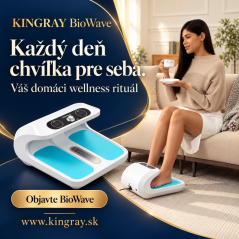
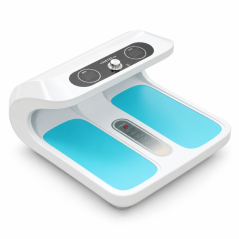
According to the supplied KB-136C manual, Rev. 01, HEAT controls only the heated belt. Its range is 0–6; 0 switches heating off. These levels are not temperatures in °C. The platform has a separate INTENSITY setting of 01–30. [5]
These control values should therefore not be confused with foot temperature. For the platform alone, the manual specifies HEAT 0; for the belt alone, INTENSITY “--”. The full instructions and restrictions in the manual remain essential.
↑ Back to questionsIs the maximum timer value the recommended session length?
No. The manual gives a TIME range of 5–60 minutes and a default of 40 minutes. These are control options, not a universal recommendation. Before starting, adjust the time to the specific mode described in the manual. [5]
The manual distinguishes separate and combined use, as well as gradual introduction. Neither the display maximum nor a scientific experiment’s parameters should be turned into a personal home protocol.
↑ Back to questionsWhat does an evening routine before bed mean?
An evening routine takes place while you are still awake and able to monitor your skin and comfort. Use only a mode and duration allowed by the device’s instructions; do not fall asleep during use.
Intense heat and sweating are not the goal. If burning, pain or another unusual reaction occurs, stop using the device and follow the manual’s safety instructions. [5]
↑ Back to questionsWhat if I cannot reliably feel warmth in my feet?
Impaired sensation can prevent timely recognition of excessive heat. For diabetic nerve damage, NIDDK specifically advises against putting a heating pad or hot-water bottle on the feet. [4]
A reduced sensation is therefore not a reason to increase the output. Discuss suitability of the particular device with a doctor and follow its instructions, including contraindications. This article does not replace them.
↑ Back to questionsWhat would support an effect claim for a particular device?
Research would need to test that device at clearly described settings: where and how temperature was measured, how long stimulation lasted, who participated and what comparison was made. The outcome measured must match the claim.
A temperature measurement alone cannot establish better sleep. A manual explains controls and restrictions; a physiological study explains the phenomenon studied. This article does not treat either as clinical evidence of BioWave’s effectiveness.
↑ Back to questionsFrequently asked questions – short answers
Is HEAT the temperature of the feet?
No. According to the KB-136C manual, HEAT controls only the belt. Levels 0–6 are not values in °C.
Is 60 minutes the recommended session length?
No. It is the timer’s upper setting limit. Use depends on the specific mode and restrictions in the manual.
Does the cited research establish better sleep after BioWave?
No. The research into sleep-onset physiology did not test this device.
Should the warmth feel as strong as possible?
No. Intense heat and sweating are not the goal. Monitor comfort and skin, and follow the manual.
Can I increase the output if I barely feel warmth?
Reduced sensation is not a reason to increase the output. Discuss suitability with a doctor and follow the manual.
Sources and supporting material
These sources describe heat transfer, physiology and safety considerations. The cited studies did not test KINGRAY BioWave.
- OpenStax: University Physics, Volume 2, §1.6. Heat transfer. Open sourceRelevant textbook sections read.
- Minson CT, Berry LT, Joyner MJ (2001). DOI: 10.1152/jappl.2001.91.4.1619. Local skin heating. Open sourceAbstract checked; the full text was not assessed.
- Kräuchi K et al. (2000). DOI: 10.1152/ajpregu.2000.278.3.R741. Sleep-onset physiology. Open sourceAbstract checked; the full text was not assessed.
- NIDDK: Diabetes & Foot Problems. Heat safety with impaired sensation. Open sourceNIDDK advice on protecting feet from heat read.
- KINGRAY BioWave KB-136C, Rev. 01. Controls and use. Supplied Slovak manual, Rev. 01, particularly pages 5–9. A source for controls and restrictions, not a clinical study. A public link is not yet available.

Recommended products1