
 Slovensky (EUR)
 Česky (CZK)
 Magyar (HUF)
 Slovenščina (EUR)
 Deutsch (EUR)


PEMF for the feet: pulsed fields and study results
PEMF for the feet: pulsed fields and study results
From a coil to an electrical stimulus: what pulsing means
People often ask whether PEMF is an ordinary magnet, whether they should feel anything and what scientists actually measure. This article explains pulsed fields and how to read the research. Article 03 covers RF heating; warmth, light and traditional points have separate articles in the series.
Simply put
A changing magnetic field can generate an electric field in tissue. Pulses describe how that stimulus changes over time. Its biological response cannot be inferred from the name PEMF alone: we need to know the signal, applicator and measurement results.
1. What does PEMF mean, and is it an ordinary magnet?
PEMF stands for pulsed electromagnetic field. A stationary permanent magnet has an approximately constant field; with PEMF, the field is deliberately varied over time. These applications are therefore not interchangeable. [2]
The term describes a family of technologies, not a single product or a uniform effect. Two devices labelled PEMF may deliver very different stimuli.
↑ Back to questions2. How is a pulsed field generated?
In a typical coil applicator, an electric current produces a magnetic field. Electronics control changes in the current and therefore the field's time course. A pulse does not necessarily mean mechanical vibration or massage of the foot. [2, 3]
This describes the general principle of a coil system. It does not confirm BioWave's construction: that requires the specific model's technical documentation.
↑ Back to questions3. What is electromagnetic induction?
A change in magnetic flux is associated with the generation of an electric field. In tissue, that field can induce electrical currents; their distribution also depends on applicator geometry and the tissue's electrical properties. [1, 3]
This is a physical mechanism for delivering a stimulus. By itself, it does not demonstrate cell renewal, improved circulation or a therapeutic outcome. Those questions require separate biological and clinical measurements.
↑ Back to questions4. Why is frequency alone not enough?
Frequency describes repetition, while magnetic flux density in tesla describes the magnitude of the magnetic component. Pulse shape and duration, rate of change, pauses and, in some systems, carrier frequency also matter. [1, 3, 8]
Comparisons also require applicator position, distance and exposure time. A display setting is not a universal unit: without manufacturer data, it cannot be converted into a tissue dose.
↑ Back to questions5. Must I feel warmth, pulsing or tingling?
Not every studied protocol is intended to produce warmth or a noticeable sensation. Nonthermal pulsed applications also exist. Feeling warmth, or feeling none, does not establish the field parameters. [8]
Do not increase a setting simply to make the stimulus noticeable. The supplied BioWave manual requires stopping use if pain, burning or unusual tingling occurs. Sensation is not a measure of effectiveness. [7]
↑ Back to questions6. Why do studies also mention pulsed RF?
Pulsed describes the time course; RF identifies the radiofrequency range. Some devices deliver an RF signal in pulses and are described in the literature as pulsed electromagnetic applications. [8]
A shared label therefore does not justify transferring results between devices. Article 03 explains RF and heating in more detail; here the focus is on the signal and how its response is tested.
↑ Back to questions7. What does an effect on cell signalling mean?
In a 2012 cell experiment, pulsed RF increased nitric oxide (NO) release. In fibroblasts, a substance acting against calmodulin, a protein involved in calcium signalling, blocked this response. [4]
This is evidence pointing to a particular mechanism in a cell culture. It does not demonstrate increased NO throughout the body or mitochondrial “charging” through the feet. The signal studied was not a validation of KINGRAY BioWave.
↑ Back to questions8. How can we distinguish a mechanism from a meaningful benefit?
Ask in sequence: was the device output measured, did a biological change occur, and did it produce an important outcome for the person? Signal measurements, cell experiments and clinical studies answer different questions.
Also examine the comparison group. An inactive device can help distinguish the effect of the signal from expectations and the natural course of symptoms. One favourable measure does not describe the entire result.
↑ Back to questions9. What did a study of blood flow in the foot find?
A 2016 randomized study included 22 people with diabetes and 21 healthy participants. It compared a 30-minute, 0.5 mT, 12 Hz protocol with an inactive application. Blood velocity in the smallest visible vein changed more favourably; vein diameter and skin blood flow showed no significant difference. [5]
Blood velocity in the observed vein and skin perfusion are different measures. This does not demonstrate better circulation throughout the body or a BioWave effect. These were experimental parameters, not instructions for home use.
↑ Back to questions10. What did a larger study of neuropathic pain find?
A 2009 double-blind randomized study followed 225 people with diabetic neuropathy for three months. The main pain-intensity scales showed no significant difference from an inactive device. Some secondary measures were more favourable. [6]
This matters too: a possible biological response may not produce the expected benefit. We do not infer a home treatment for neuropathy or repair of damaged nerves using BioWave from this study.
↑ Back to questions11. Does application to the feet mean an effect on every organ?
The extent of the stimulus depends on the actual field distribution. Foot placement, an indicator light or a subjective sensation does not reveal the field at a distant organ. [1, 3]
The experiments discussed do not establish transmission of an effect through reflex zones to the whole body. Examining a local vessel or a cell culture cannot support that conclusion. Article 06 addresses traditional points.
↑ Back to questions12. What does the BioWave manual tell us, and how should we use that information?
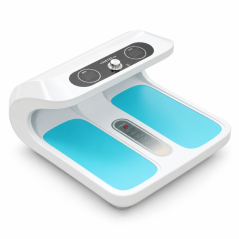
The supplied KB-136C manual, Rev. 01, describes the controls but does not specify the frequency, magnetic flux density or PEMF pulse waveform needed for a research comparison. An INTENSITY number therefore cannot be matched to a published dose. [7]
Follow the complete manual, including prohibited uses. It prohibits use with a pacemaker; a low setting does not remove that restriction. Contact surfaces must remain dry, without water or gel, and the device is used seated and awake. Guide 01 covers the detailed procedure. [7]
↑ Back to questionsFrequently asked questions – short answers
Is PEMF the same as a permanent magnet?
No. PEMF generates a field that varies in pulses; a stationary permanent magnet has an approximately constant field.
Must I feel something during use?
A noticeable sensation is not a measure of dose or effectiveness. Do not increase a setting just to feel something; follow the manual and stop use if unpleasant symptoms occur.
Is a higher INTENSITY number better?
A higher number alone does not demonstrate greater benefit. Without technical data it cannot be converted into a PEMF dose.
Do the studies cited demonstrate a BioWave effect?
No. They examined other devices, signals or cell cultures. They illustrate the mechanism and the limits of the research.
Can BioWave be used at a low setting with a pacemaker?
No. The supplied KB-136C manual prohibits use with a pacemaker; a low setting is not an exception.
Sources and supporting material
These sources explain physics, methods and specific experiments. They do not demonstrate the effectiveness of KINGRAY BioWave.
- ICNIRP: Low frequency (1 Hz–100 kHz). Open sourceRelevant sections on fields and induced currents read; this does not validate a particular device.
- NCCIH: Magnets For Pain: What You Need To Know. Open sourceSections on permanent magnets, electromagnets and safety restrictions read.
- OpenStax: University Physics, Volume 2, § 13.4. Open sourcePhysics explanation of induced electric fields read; this is not a clinical study.
- Pilla AA (2012). DOI: 10.1016/j.bbrc.2012.08.078. Open sourceAbstract checked; the full study text was not assessed.
- Sun J et al. (2016). DOI: 10.1002/bem.21983. Open sourceAbstract checked; the full study text was not assessed.
- Weintraub MI et al. (2009). PMID: 19577022. Open sourceAbstract checked; the full study text was not assessed.
- KINGRAY BioWave KB-136C, Rev. 01. Supplied Slovak manual read. A source for controls and prohibited uses, not PEMF measurement or a clinical study. A public PDF link is not yet available.
- FDA: Product Classification PQY. Open sourceDefinition and technical principle of nonthermal pulsed RF devices read. This US category does not establish BioWave’s classification or permitted claims in the EU.

Recommended products1