
 Slovensky (EUR)
 Česky (CZK)
 Magyar (HUF)
 Slovenščina (EUR)
 Deutsch (EUR)


Radiofrequency for the feet: RF, warmth and research

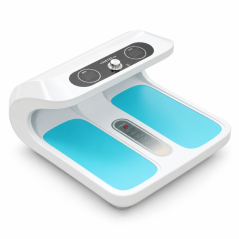
Illustration of the feet. The coloured waves do not represent a measurement of the RF signal or penetration depth.
Radiofrequency for the feet: RF, warmth and research
From an electrical signal to heat: what we can explain and what needs measuring
People asking about radiofrequency often want to understand radiation, penetration depth and the meaning of warmth. This article explains the physical mechanism of RF. Article 04 covers blood vessels’ responses to heat and connections with sleep; light, PEMF and traditional points have their own articles in the series.
Simply put
RF refers to rapid electrical and magnetic oscillation. Some energy absorbed by tissue can become heat. How much, and where, depends on the actual output and applicator. Neither the name RF nor a sensation of warmth determines the dose or a health benefit.
1. Does radiofrequency mean radioactivity?
No. RF is a non-ionizing electromagnetic stimulus, not radioactive material or X-rays. Non-ionizing describes the energy of the radiation; it does not automatically establish the safety of every device. [1]
For practical use, the particular model, its output, technical safety and instructions matter. The word “radiofrequency” alone is not a reason for alarm, but it cannot replace this information.
↑ Back to questions2. Where does an RF signal come from?
An electronic generator produces rapidly changing voltage and current. An applicator transfers energy to an area and may use electrodes or a coil. Different designs cannot be treated as equivalent simply because they share the name RF. [2]
Think of the sequence: energy source → generator → applicator → tissue. This is a physical transfer of energy. It is not evidence of “charging cells” or directly replenishing ATP.
↑ Back to questions3. How does RF energy become heat?
An alternating electric field acts on charges and polarization within tissue. As energy is absorbed, conductive and dielectric losses can produce heat. Put simply, some electrical energy becomes thermal energy. [2, 7]
This explains a possible heating mechanism. It does not establish how much energy a particular device transfers to the feet or what result a person will feel. A general principle must be distinguished from measurements of a specific product.
↑ Back to questions4. Is RF the same as a heated pad?
With ordinary contact heating, heat passes from a warm surface to the skin. With RF, heat can also develop within tissue through electromagnetic energy absorption. A combined device may have several heat sources. [2]
Pleasantly warm feet do not reveal which source contributed to that sensation. Warmth also cannot establish the presence of an RF, infrared or terahertz output. Technical documentation and measurements are needed for that.
↑ Back to questions5. How does RF differ from PEMF and pulsed operation?
RF describes a frequency region; pulsed describes a signal’s timing. RF can be continuous or delivered in pulses. PEMF means a pulsed electromagnetic field; some terminology may overlap in the literature. [3]
Comparison therefore requires both the carrier frequency and pulse information. The label PEMF or RF alone does not mean the same technology or dose. Article 02 explains pulsed fields in more detail.
↑ Back to questions6. Is a higher frequency or display number better?
Frequency is the number of oscillations per second; power is the rate of energy transfer. These are different quantities. One megahertz means a million oscillations per second, not a certain number of watts or a particular temperature.
A control level is a product setting. Without the manufacturer’s data, it cannot be converted into RF power, absorbed dose or depth. A higher number alone does not establish a better result; devices should not be compared only by the highest number on their displays.
↑ Back to questions7. Must RF pulse, or must I feel it?
Not every RF signal is pulsed. With pulses, their duration and the intervals matter too. Pulsed operation can produce heating; shortwave modes intended to act without therapeutically significant heating also exist. [3]
Warmth, tingling or their absence are not measures of RF dose. Do not increase a setting simply to create a strong sensation. User settings follow the instructions, not an expectation that an effect must be strongly felt.
↑ Back to questions8. Can a sensation tell me the penetration depth?
No. Energy distribution depends on frequency, the applicator, contact and tissue properties. A thermal camera shows surface temperature; it does not itself measure the temperature of muscle or connective tissue beneath the skin. [2, 7]
We therefore give no universal depth in centimetres or claim that warmth through the feet reaches a particular organ. Any depth claim would require measurement or a validated model for that device and method of use.
↑ Back to questions9. What does research into RF heating show?
A randomized crossover study (2015; 15 healthy people) found increased skin temperature after 448 kHz RF applied to the lower thigh. [4]
This illustrates a measurable thermal response under a specific protocol. Skin temperature is not a measurement of cell renewal or disease treatment. The experimental setting is not an instruction for home use. The device studied was not KINGRAY BioWave.
↑ Back to questions10. What has been studied directly on the foot?
An open controlled study (2024; 20 healthy people) recorded temperature changes, but no change in plantar fascia viscoelasticity immediately or after one week. [5]
The plantar fascia is a band of connective tissue beneath the foot; viscoelasticity describes its mechanical behaviour. A temperature change need not mean a change in connective tissue properties. This was neither a BioWave trial nor evidence that this device treats a painful foot.
↑ Back to questions11. What can the manual tell us about BioWave?
The KB-136C manual, Rev. 01, describes controls and restrictions on use. However, it does not give the RF frequency and output characteristics needed for comparison with studies. The INTENSITY setting does not establish an RF dose. [6]
Identifying a specific RF mechanism requires knowledge of the actual output, applicator and energy transfer. This article therefore explains the technology in general; it does not establish equivalence between BioWave and the RF devices studied. Guide 01 covers controls and operating modes.
↑ Back to questions12. What matters for calm and correct use?
First read the full instructions, including when the device must not be used. For BioWave, the supplied manual requires dry contact surfaces without water or gel, and use while seated and awake. Stop the output before repositioning the feet. [6]
Pain or burning is neither a goal nor proof of effectiveness: stop using the device. Prohibitions in the instructions also apply at low settings. With reduced sensation, do not rely on warmth alone; assess suitability using the instructions and with a healthcare professional. [6]
↑ Back to questionsFrequently asked questions – short answers
Does RF mean radioactivity?
No. RF is a non-ionizing electromagnetic stimulus. A specific device’s safety depends on its output, design and adherence to its instructions.
Are all RF devices the same?
No. Frequency, power, pulses, applicators and application sites may differ. A shared name is not enough to compare effects.
Does stronger warmth prove a better effect?
No. Warmth does not measure RF dose or a health outcome. A higher setting is not automatically better.
Can a thermal camera establish penetration depth?
A thermal camera alone shows surface temperature. It does not establish the depth of heating within tissue.
Do the cited studies prove an effect of BioWave?
No. They investigated other devices and protocols. Here they illustrate mechanisms and the limits of measurement.
Sources and supporting material
These sources explain the technology and measurement methods. The research cited did not test KINGRAY BioWave.
- NCI: Radiofrequency radiation. Open sourceDefinition of non-ionizing RF read.
- FDA: Diathermy (1973). Open sourceHistorical technical explanation of applicators read. Its old treatment parameters and safety recommendations are not adopted here.
- eCFR: 21 CFR § 890.5290. Open sourceDistinction between thermal and nonthermal shortwave devices read. This US regulation is not used to establish BioWave’s classification or permitted claims in the EU.
- Kumaran B, Watson T (2015). DOI: 10.3109/02656736.2015.1092172. Open sourceAbstract checked; the full text was not assessed.
- Aguilar-Nuñez D et al. (2024). DOI: 10.1080/02656736.2024.2366429. Open sourceAbstract checked; the full text was not assessed.
- KINGRAY BioWave KB-136C, Rev. 01. Supplied Slovak manual read. A source for controls and restrictions, not independent RF measurement or a clinical study. A public PDF link is not yet available.
- ICNIRP: RF EMFs. Open sourceRelevant sections on energy absorption and heating read. This is not certification of a particular product.

Recommended products1