

 Slovensky (EUR)
 Česky (CZK)
 Magyar (HUF)
 Slovenščina (EUR)
 Deutsch (EUR)


Artemisinin: discovery, Tu Youyou and Project 523

This article is part 07 of the Substances and ingredients series.
The story of artemisinin begins with sweet wormwood and historical Chinese texts. Discover Tu Youyou, Project 523 and the milestones of a discovery that led to a Nobel Prize. With a clear timeline, explanations of key terms and answers to common questions.
Substances and ingredientsOpen the series contentsClose the series contents
Short answer: artemisinin is a compound originally isolated from sweet wormwood. Its discovery is associated with Tu Youyou’s team, Project 523 and the 2015 Nobel Prize.
In this article
Where does the name artemisinin come from?
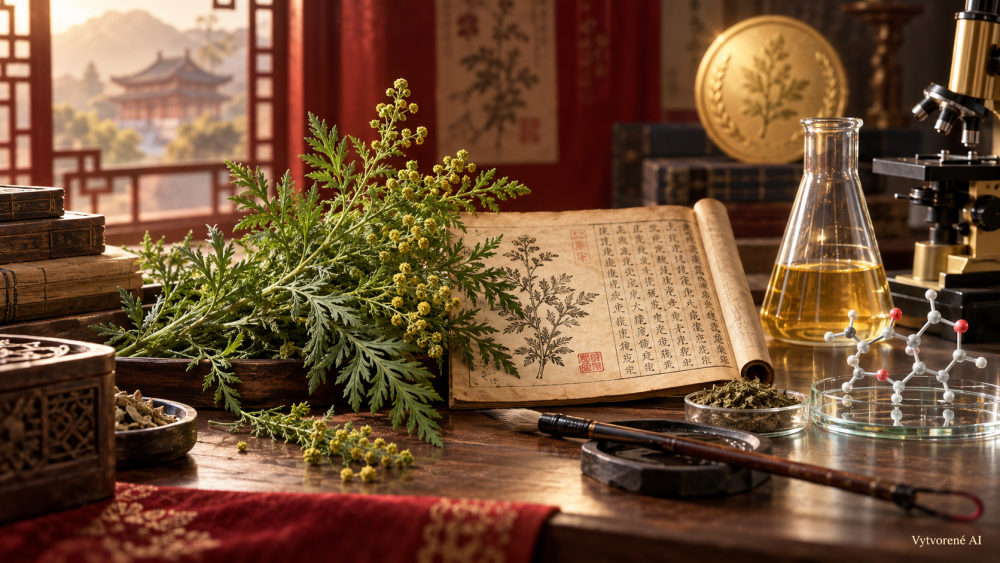
Artemisinin is a specific organic compound originally isolated from sweet wormwood (Artemisia annua). The name of the substance and the botanical name of the plant therefore do not mean the same thing. The plant contains several natural constituents; the isolated substance has its own chemical identity.
The Chinese names qinghao and qinghaosu also appear in the story of the discovery. When reading sources, it helps to know which term the author means. Similar names alone do not imply the same composition.
What caught the researchers’ attention in the old text?
One historical clue came from a text by the Chinese scholar Ge Hong, dating from the 4th century. Tu Youyou noticed that the old method described processing the plant without prolonged boiling. This detail prompted a fresh look at the laboratory procedure.
The key was not to repeat tradition without question. A historical observation became a question that could be tested experimentally. Researchers compared processing methods and used the results to guide further work.
What was Project 523?
Project 523 began in China in 1967. Its name refers to the date, 23 May. Several teams worked with different substances and plant materials as part of this extensive research programme.
Tu Youyou led a group that studied historical records and plant sources. The work involved gathering information, selecting materials, preparing samples and comparing results. The discovery emerged gradually through collaboration between several specialists.
It is important to distinguish the start of the programme, the preparation of an extract and the isolation of a compound. These are different milestones, which explains why articles about artemisinin may give different years.
Timeline: from a historical text to a Nobel Prize
- 4th century
Ge Hong’s text
The historical record later provided a clue for research.
- 1967
Project 523 begins
An organised research programme was established.
- 1971
A change in the extraction procedure
Tu Youyou’s team obtained an important result while working with the extract.
- 1972
Isolation of the crystalline compound
Research progressed from a plant mixture to a specific compound.
- 1981
International scientific meeting in Beijing
The Chinese findings were presented to a wider scientific audience.
- 2015
Nobel Prize
Tu Youyou received half of the Nobel Prize in Physiology or Medicine.
1971 is associated with the breakthrough in extraction, while 1972 marks the isolation of the crystalline compound. These dates do not conflict: they describe two stages of the same research story.
Why was isolation a separate step?
A plant extract is a mixture. Isolation separates a specific substance from that mixture so it can be identified and analysed further. It is therefore not enough to say that scientists studied wormwood: the sample they used and the stage of their work matter.
The terms below describe scientific processes. They are not instructions for preparation at home, nor do they establish the properties of any particular commercial product.
Extraction
A mixture of selected constituents is obtained from plant material.
Isolation
A specific compound is separated from the mixture.
Identification
Analytical methods help establish which substance has been obtained.
Verification
Further tests assess the results under defined conditions.
What did the 2015 Nobel Prize recognise?
In 2015, Tu Youyou received half of the Nobel Prize in Physiology or Medicine. William C. Campbell and Satoshi Ōmura shared the other half. The award belongs to the history of scientific discovery and also highlights the long journey from an initial idea to verification.
When reading articles and advertisements, it is important to distinguish recognition of a scientific discovery from an assessment of a particular product on sale. The Nobel Prize is not a certification of an herbal tea, extract or food supplement.
Sources: [4]
What can we learn from this history?
The story of artemisinin is particularly interesting because it brings together historical texts, systematic laboratory experiments and collaboration between research teams. It shows why the precise identity of a plant, the sample used and the method applied change what a result means.
As you read further, ask three questions: Who is providing the information? What material are they referring to? What period does the information come from? This helps avoid confusing the history of the discovery with present-day marketing claims.
How do these distinctions apply when reading a label or a scientific study? The forthcoming article 08 in this series: Artemisia annua and artemisinin will explore the differences between the plant, powder, extract and isolated compound.
Simply put
An old text provided an idea, but the discovery required laboratory work. The plant, an extract and isolated artemisinin are different things. The Nobel Prize recognised a scientific discovery; it does not establish the effects of any arbitrary herbal preparation.
Frequently asked questions
Which plant was artemisinin isolated from?
From sweet wormwood, botanically Artemisia annua. Artemisinin is one specific compound, not the entire plant.
Who is Tu Youyou?
A Chinese scientist associated with the discovery of artemisinin. In 2015, she received half of the Nobel Prize in Physiology or Medicine.
What does the number 523 mean?
It refers to 23 May, the date on which the Chinese research programme began in 1967.
Why are both 1971 and 1972 mentioned?
1971 is associated with the breakthrough in extraction; 1972 with the isolation of the crystalline compound. These were different stages of the work.
Was the Nobel Prize awarded to an herbal supplement?
No. The award recognises Tu Youyou’s scientific discovery. It does not establish the properties of individual products.
Where can I read about the difference between a powder and an extract?
The forthcoming article 08 in this series, Artemisia annua and artemisinin, will explain these differences.
Sources and further reading