

 Slovensky (EUR)
 Česky (CZK)
 Magyar (HUF)
 Slovenščina (EUR)
 Deutsch (EUR)


KINGRAY ACADEMY · DIGESTION AND GUT HEALTH · 07
Who produces intestinal mucus, and how is its protective layer renewed?
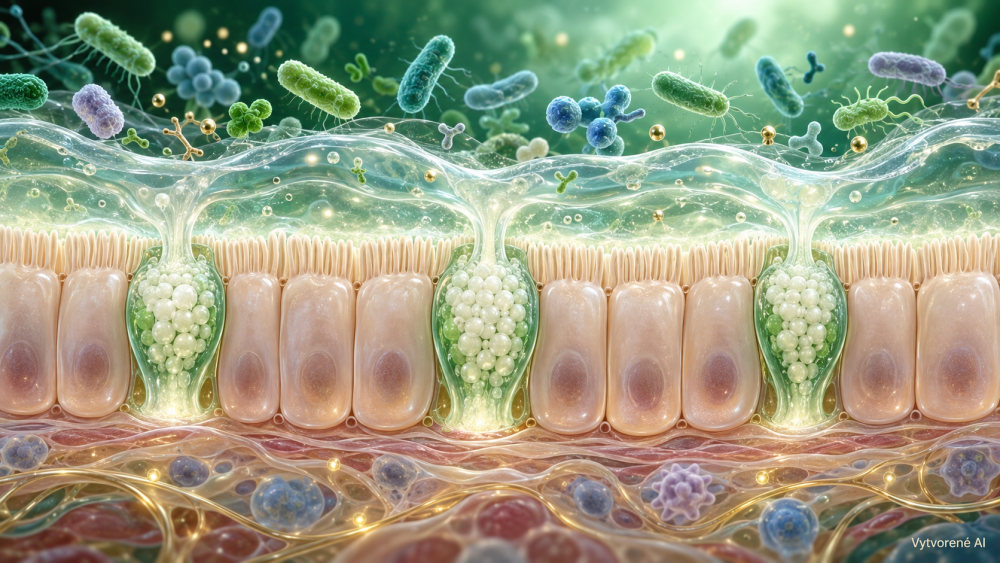
Intestinal mucus is produced mainly by epithelial goblet cells. MUC2 mucin is a major component of its gel network. Mucus is continually replenished and remodelled; this is distinct from renewing epithelial cells or “resetting” the microbiome. [1] [2]
Clear comparison tables explain the parts of the barrier, differences between the small intestine and colon, and interactions with bacteria. We separate mouse experiments on fibre from demonstrated outcomes in people.
What is the difference between mucus, epithelium and the microbiome?
The gut is not lined only by mucus. Its surface is an epithelium: a living layer of cells. Mucus lies above it and is one component of the intestinal barrier. The microbiome refers to the microbial community and its genetic and functional context; it is not the name of the mucus layer.
These parts work together but have different roles. Mucus hydrates the surface, lubricates the passage of contents and helps separate them from epithelial cells. The barrier also includes cell junctions, defensive molecules and the mucosal immune system.
| Term | Meaning | Key distinction |
|---|---|---|
| TermIntestinal epithelium | MeaningLiving cells at the gut surface. | Key distinctionNot the same as mucus. |
| TermIntestinal mucus | MeaningA water-rich gel containing mucins. | Key distinctionContinuously produced and remodelled. |
| TermMUC2 mucin | MeaningA major gel-forming mucin. | Key distinctionA mucus component, not a bacterium. |
| TermGut microbiota | MeaningA community of microorganisms. | Key distinctionInteracts with mucus but does not make human MUC2. |
| TermIntestinal barrier | MeaningConnected protective and regulatory mechanisms. | Key distinctionMore than one layer. |
Who produces mucus, and what does MUC2 do?
Goblet cells, which belong to the intestinal epithelium, are the main producers. They make and release mucins: large proteins bearing carbohydrate chains, known as glycoproteins. MUC2 is a major gel-forming intestinal mucin.
After release and hydration, mucin structures expand and form a gel network. The resulting mucus contains water and other components, including defensive molecules.
How is the intestinal mucus layer renewed?
Mucus is not a permanent coating. Goblet cells continually replenish it. Released mucins change their organisation; mucus moves and its components undergo enzymatic and microbial processing.
- Production: goblet cells synthesise and prepare mucins for release.
- Release and hydration: mucins form a hydrated network at the surface.
- Remodelling: mucus moves and changes; some microorganisms use its components.
- Replenishment: new secretion replaces material that is removed.
Mucus renewal and cell turnover are different processes. New epithelial cells arise from stem cells in intestinal crypts. Rates differ by region and conditions, so there is no single universal time for “renewing the whole gut”.
Is mucus organised the same way in the small intestine and colon?
No. Its organisation changes along the digestive tract. A simplified model helps explain the differences, but gut regions and experimental models are not identical.
| Region | Typical organisation | Why it matters |
|---|---|---|
| RegionSmall intestine | Typical organisationLooser, less adherent mucus. | Why it mattersPart of the environment for digestion and absorption, alongside other defences. |
| RegionColon: inner layer | Typical organisationDenser mucus next to the epithelium. | Why it mattersNormally limits bacterial access to cells. |
| RegionColon: outer layer | Typical organisationLooser mucus towards the lumen. | Why it mattersProvides microbial habitats and interactions with mucins. |
The two-layer model mainly describes colonic mucus. It should not be transferred unchanged to the whole small intestine. Johansson and colleagues’ 2008 work was an experimental study, including mouse models; its measurements are not a universal thickness standard for people.
How do bacteria interact with intestinal mucus?
The relationship works in both directions. Mucus helps create microbial habitats, and microbes can influence its properties. Some use the carbohydrate chains of mucins; others process food components. Using mucin is not automatically a harmful activity.
Fermentation of some carbohydrates also produces short-chain fatty acids. Microbial metabolites participate in communication with gut cells. This does not mean that more of one bacterium always indicates a healthier barrier.
Digestion and gut health: what causes problems and when to seek help?
What did the fibre research show, and where are its limits?
Desai and colleagues’ 2016 study examined mice colonised with a defined community of human gut microorganisms. Under fibre-deprived conditions, the microbes made greater use of host mucus carbohydrates, and researchers observed erosion of the mucus barrier and greater susceptibility to a pathogen in that model.
This is a mechanistic finding under specific experimental conditions. It is not a clinical demonstration that a particular food or supplement restores human mucus, nor a universal fibre dose for every person.
| Finding | Appropriate interpretation | Overstatement to avoid |
|---|---|---|
| FindingGoblet cells make mucus. | Appropriate interpretationProduction is a function of host cells. | Overstatement to avoidProbiotics directly manufacture human mucus. |
| FindingSome bacteria use mucin. | Appropriate interpretationMucin participates in microbial relationships. | Overstatement to avoidAny use of mucin is harmful. |
| FindingFibre affected mucus in mice. | Appropriate interpretationDiet and microbes can influence barrier properties in a model. | Overstatement to avoidThe same result and dose are established for everyone. |
| FindingA study tests one preparation. | Appropriate interpretationConclusions belong to the tested form and conditions. | Overstatement to avoidEvery similarly named product works the same way. |
Can probiotics, inulin or glutamine rebuild the mucus layer?
The word “probiotic” or a large CFU count cannot establish mucus restoration. Evidence must concern the specific strain, preparation, outcome and population. A change in a laboratory marker also needs to be distinguished from a meaningful clinical benefit.
Simply adding inulin, glutamine or a vitamin to a mixture does not prove an effect on mucus. An ingredient list describes composition; a statement that a product “repairs the gut barrier” requires evidence for that outcome. One is not a substitute for the other.
Dietary fibre can be part of a varied diet, but the mouse experiment does not justify a restrictive “barrier repair” plan or indiscriminate high doses. Tolerance and diagnosed digestive conditions should guide individual dietary changes.
In plain language
Your own goblet cells make mucus, with MUC2 forming an important part of the gel. The layer is continually replenished and its organisation varies along the gut. Bacteria interact with it, but they do not make human mucus.
A plausible biological mechanism, a mouse experiment and a proven benefit for a person are different levels of evidence. This article explains the biology; it does not diagnose a damaged barrier or prescribe a guaranteed way to “repair” it.
Frequently asked questions
Who makes intestinal mucus?
Mainly goblet cells in the intestinal epithelium. They produce and release mucins that form the mucus network.
What is MUC2?
MUC2 is a major gel-forming intestinal mucin: a glycoprotein with attached carbohydrate chains.
Are mucus and the intestinal lining the same thing?
Do bacteria produce human mucus?
How many days does mucus renewal take?
It is continuous. There is no single number of days for every gut region and situation. Mucus renewal also differs from epithelial cell turnover.
Does a mouse study prove an effect in people?
Not automatically. It describes mechanisms in a particular experimental model and does not directly confirm the same outcome in humans.
Can the CFU count predict mucus restoration?
No. CFU alone does not establish an outcome. Evidence must match the strain, preparation and claim.
Scientific references
Numbers in the text refer to the sources below. This article explains research and its limits; it does not replace an individual assessment or treatment plan.
- Johansson et al. (2008): The inner of the two Muc2 mucin-dependent mucus layers in colon is devoid of bacteria
- Pelaseyed et al. (2014): The mucus and mucins of the goblet cells and enterocytes provide the first defense line of the gastrointestinal tract and interact with the immune system
- Desai et al. (2016): A Dietary Fiber-Deprived Gut Microbiota Degrades the Colonic Mucus Barrier and Enhances Pathogen Susceptibility
- Porcari et al. (2025): International consensus statement on microbiome testing in clinical practice
- NCCIH: Probiotics — Usefulness and Safety