

 Slovensky (EUR)
 Česky (CZK)
 Magyar (HUF)
 Slovenščina (EUR)
 Deutsch (EUR)


STIMLIGHT 850 nm: the infrared attachment and how to use it
KINGRAY GUIDE · BIOLAMPS AND LIGHT
What does STIMLIGHT 850 nm mean, and why can you barely see the light?
850 nm is a wavelength in the near-infrared range, which the human eye does not normally perceive. It is neither a power rating nor an application time. [2]
The infrared attachment adds another part of the spectrum to the device. Here you can learn how it differs from the red attachment and what to prepare before using it.

Hello! Today we will explore what 850 nm means and how to understand the STIMLIGHT infrared attachment.
Contents and articles about biolamps
The technical information comes from the STIMLIGHT_002 manual (2018). Always compare it with the instructions supplied for your model and attachment. STIMLIGHT is presented here as a device for a home wellness routine. [1]
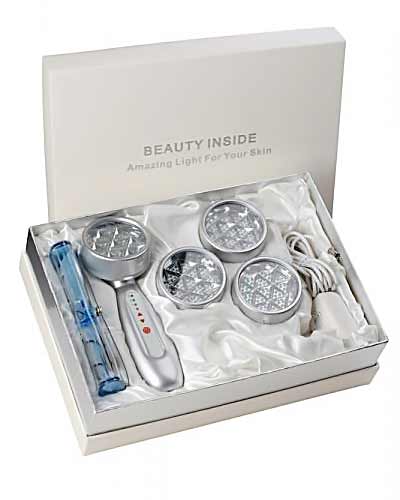
How do the red and infrared attachments differ?
Red attachment
625 ± 3 nmVisible red light, as specified in the manual cited here. [1]
Infrared attachment
850 nmNear-infrared light. Being barely visible does not by itself indicate a fault. [1]
Simply put: 850 nm does not mean ‘stronger red’. It is a different wavelength with its own instructions for use.
Which numbers describe the light and which describe the dose?
nm · wavelengthIdentifies a region of the light spectrum.
mW or W · optical powerEmitted energy per unit of time, rather than electrical power drawn from the socket. [5]
mW/cm² · irradianceOptical power reaching a unit of surface area at a specified distance. [5]
J/cm² · radiant exposureEnergy delivered per unit of area during an application. [4]
Hz · pulsingNumber of pulses per second. This is neither wavelength nor power.
Distance and timePart of the specific procedure; do not estimate them from brightness.
The manual describes 2 Hz, 20 Hz and continuous light. For the infrared attachment, check the available mode and its corresponding time. Do not automatically apply the cosmetic timing table for coloured attachments to 850 nm. [1]
What should you check before using the infrared attachment?
Check the exact model and attachment.
Confirm compatibility, device condition and the instructions for 850 nm. If the manual gives no time or distance, request this information before use. [1]
Prepare your skin and eye protection.
Follow the instructions. Do not look directly into the source or treat closed eyelids as a substitute for the specified protection. [1]
Use the specified mode and time.
Fit the attachment while the device is switched off. Keep the prescribed position and distance; dim light is no reason to move it closer or extend an application. [1]
Switch the device off afterwards.
Clean and store it according to the instructions. Stop using it if you experience burning, irritation or overheating. [1]
Check the contraindications in the manual before use. Pay particular attention to medicines that increase sensitivity to light, eye conditions, epilepsy, pregnancy and cancer. If unsure, consult a doctor; the device does not replace assessment of pain or other health problems. [1]
Full instructions for changing attachments and using STIMLIGHT →What does research show about light penetration?
Transmission measurements · Jagdeo et al., 2012
An experiment including cadaver tissue found greater transmission at 830 nm than 633 nm. It tested neither STIMLIGHT nor joint treatment. [3]
Open source →PBM parameters · Zein et al., 2018
The review highlights varying settings and study outcomes. Wavelength alone is insufficient to determine a suitable application. [4]
Open source →Simply put: Measurable light penetration and a proven health benefit are different findings. Results from another source do not automatically apply to this attachment.
More about biolamp effects and the limits of research →Common practical questions
Should I feel heat at 850 nm?
Do not use warmth to check whether the device works or to time an application. Follow the instructions and stop if the heat becomes uncomfortable. [1]
Is the infrared attachment a laser?
No. STIMLIGHT is an LED device. The designation 850 nm describes wavelength, not the type of light source. [1]
Can I use gel or cosmetic cream?
Only if that product and procedure are permitted for your model. Instructions for ultrasound or galvanic devices do not automatically apply to a light attachment. [1]
How can I tell whether the attachment works?
Use the checking procedure in the manual or contact the service provider. Never test it by looking directly into the LEDs or rely on visible brightness alone. [1]
Will the attachment fit an older STIMLIGHT?
Check the model and version with the seller. The same device name or a similar connector does not, by itself, establish compatibility. [1]
Does 850 nm tell me how deeply the light acts?
No. Source parameters and tissue properties also matter. Without measuring the specific setup, a depth in centimetres or an effect inside a joint cannot be promised. [3]
References
- STIMLIGHT_002_oz.pdf, STIMLIGHT manual (2018), pp. 10–17: safety, attachments, modes and use.
- NASA Science: Infrared Waves – the infrared region of the spectrum.
- Jagdeo et al. (2012): experimental measurements of red and near-infrared light transmission.
- Zein, Selting and Hamblin (2018): review of photobiomodulation parameters. DOI: 10.1117/1.JBO.23.12.120901.
- NIST, Ohno (2000): radiometry, optical power and irradiance – publication abstract.
This article is educational. It does not replace a medical assessment or individual clinical advice for health concerns.