

 Slovensky (EUR)
 Česky (CZK)
 Magyar (HUF)
Medicinal mushrooms: Reishi, Cordyceps, Lion’s Mane, Chaga and extract quality
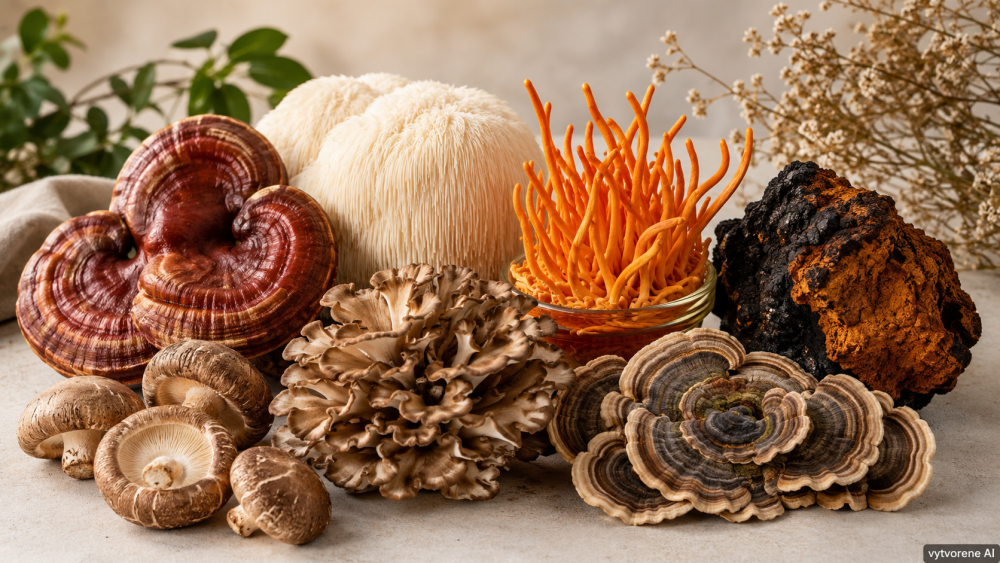
“Medicinal” mushrooms: what they contain, how they differ and how to assess their quality
Reishi, Cordyceps, Chaga, Maitake, Lion’s Mane, Shiitake and Turkey Tail are used in different parts of the world as foods or traditional fungal ingredients. Today, they are also found in food supplements.
The term “medicinal mushroom” is not synonymous with a medicine. Mushroom species differ in their chemical composition, and two products bearing the same mushroom name may contain very different amounts of individual naturally occurring compounds.
Traditional use, chemical composition, laboratory research, a clinical study and an authorised health claim are different concepts. The findings of a scientific experiment cannot automatically be applied to a particular food supplement.
Mushroom polysaccharides
They form part of the cell walls of many fungi. Their amounts and structures vary between species.
The visible part of the mushroom
Its chemical composition may differ from that of the mycelium.
A more concentrated form
Its properties depend on the raw material, extraction process and standardisation.
A different product category
A food supplement cannot automatically be attributed the properties of a pharmaceutical medicine.
What does the term “medicinal mushrooms” mean?
“Medicinal mushrooms” is a general term used for certain mushroom species with a long history of traditional use that are also the subject of scientific interest.
The term itself does not mean that a preparation is a medicine or has a proven therapeutic effect.
When assessing a food supplement, it is therefore important to consider its precise composition, raw material, quantities of individual ingredients and manufacturing quality.
What do mushrooms naturally contain?
Fungi have a different cellular structure from plants. Their cell walls contain, for example, chitin and various polysaccharides. Depending on the species, a wide range of other compounds can also be found.
Their proportions depend on the mushroom species, the part used, growing conditions, maturity of the raw material, drying method and extraction process.
Beta-glucans: what does this label information mean?
Beta-glucans are polysaccharides naturally present in the cell walls of many fungi.
However, not all beta-glucans have the same chemical structure. They may differ in:
- molecular weight,
- solubility,
- degree and pattern of branching,
- linkages between individual glucose units.
A total polysaccharide figure may include several different carbohydrate components. When comparing two mushroom extracts, a specific beta-glucan content figure may be more informative than “total polysaccharides” alone.
Health claims relating to beta-glucans from one specific source cannot automatically be applied to beta-glucans from another source. The exact substance and the conditions of the particular claim matter.
Well-known species and their characteristic compounds
The following overview describes chemical components studied or identified in individual mushrooms. It is not a list of health benefits or therapeutic effects.
Reishi – Ganoderma lucidum
Reishi, also known as Lingzhi, is among the best-known traditionally used mushrooms.
Its composition is commonly described in terms of:
- beta-glucans and other polysaccharides,
- triterpenes, including ganoderic acids,
- sterols,
- peptides and other naturally occurring compounds.
The amounts of individual compounds depend on the mushroom part used and the processing method.
Cordyceps
The name Cordyceps may refer to several species and cultivation methods.
Preparations may be analysed for:
- polysaccharides,
- sterols,
- amino acids,
- nucleosides, including adenosine.
Another frequently mentioned compound is cordycepin. Its content depends greatly on the species. More substantial quantities are associated particularly with Cordyceps militaris.
Lion’s Mane – Hericium erinaceus
Lion’s Mane – Hericium erinaceus – contains beta-glucans and other naturally occurring compounds.
Two groups of compounds are of particular interest:
- hericenones – associated mainly with the fruiting body,
- erinacines – found mainly in the mycelium.
This is why it is important to know whether a Lion’s Mane product uses the fruiting body, mycelium or a combination of the two.
Chaga – Inonotus obliquus
Chaga typically grows on birch trees in colder regions of Europe, Asia and North America.
It contains, for example:
- polysaccharides,
- polyphenolic compounds,
- melanin-related compounds,
- sterols,
- triterpenes.
The host tree and processing method may strongly influence its composition.
Maitake – Grifola frondosa
Maitake – Grifola frondosa – is an edible mushroom naturally containing various polysaccharides, including beta-glucans.
Descriptions of extracts may also refer to specific polysaccharide fractions, such as the D-fraction.
Shiitake – Lentinula edodes
Shiitake is a common edible mushroom and a source of several naturally occurring compounds.
- beta-glucans,
- lentinan,
- eritadenine,
- ergosterol,
- other polysaccharides and sterols.
Ergosterol is a naturally occurring fungal compound that can be converted to vitamin D₂ by exposure to UV radiation.
Turkey Tail – Trametes versicolor
Turkey Tail – Trametes versicolor – contains beta-glucans and protein-bound polysaccharide components.
The scientific literature includes the terms:
- PSK – polysaccharide K,
- PSP – polysaccharide peptide.
A precisely standardised fraction is not automatically equivalent to ordinary whole-mushroom powder.
Phellinus mushrooms
Mushrooms of the genus Phellinus have a long history of use in East Asia.
Their composition is described as including:
- polysaccharides,
- polyphenolic compounds,
- hispidin-derived compounds.
Quick comparison: what characterises each mushroom?
Fruiting body or mycelium?
A fungus consists of more than the part we see above the surface.
The visible reproductive part of the fungus. Its composition may have different proportions of naturally occurring compounds from the mycelium.
A network of fungal filaments. During cultivation, it may be grown on grain or another substrate.
Neither form is automatically “good” or “bad”. The mushroom species, the manufacturer’s aim and the declared composition matter.
If a substantial amount of residual growing substrate enters the finished product, its starch and total carbohydrate content may increase. It is therefore useful to check specific beta-glucan figures and the product’s composition.
Powder or extract?
Dried and ground mushroom. The amounts of individual compounds depend on the natural raw material.
Selected soluble components have been obtained from the raw material through a particular extraction process.
The manufacturer declares a specific quantity of a selected characteristic compound or group of compounds.
A statement such as “500 mg Reishi” does not, by itself, tell you whether the ingredient is an ordinary powder, a concentrated extract or a standardised extract.
What does the extraction ratio mean?
A label may show a ratio such as 10 : 1. In simplified terms, it indicates the amount of original raw material used to produce the extract.
It also matters which compounds were extracted, which raw material was used and whether the manufacturer specifies standardised components.
How can you compare mushroom supplement quality?
- the exact mushroom species – ideally its Latin name,
- the part used – fruiting body, mycelium or a combination,
- the quantity per daily serving,
- whether it is a powder or an extract,
- the extraction ratio, if stated,
- the declared beta-glucan content,
- other standardised components, if specified by the manufacturer,
- raw material identity testing,
- heavy metal testing,
- microbiological quality,
- the manufacturer and batch number.
If we do not know the amounts of individual mushrooms, the part used, extract form and standardisation, the number of species tells us little about product quality.
Traditional use, research and clinical evidence
Historical use of a food or fungal ingredient in a particular culture.
Experiments involving specific compounds, cells or model systems.
Evaluates a particular product or substance, dose and outcomes in people.
A legally defined category for the commercial communication of foods.
These four levels must not be confused. The fact that a substance has been studied in a laboratory does not mean that a particular supplement has a proven health effect.
Medicinal mushrooms and EU health claims
In the European Union, food supplements are subject to rules on nutrition and health claims.
Scientific findings or traditional use cannot therefore automatically be turned into commercial claims that a particular product supports immunity, improves memory, increases performance, acts against inflammation or treats a particular disease.
- “boosts immunity”,
- “improves memory”,
- “treats inflammation”,
- “lowers blood sugar”,
- “increases physical performance”,
- “protects against cancer”,
- “replaces treatment”.
The legal status and exact conditions of use of each specific claim must be checked. Foods and food supplements must not be attributed properties of preventing, treating or curing a human disease.
When is extra caution appropriate?
A plant or fungal origin does not mean that a concentrated supplement is automatically suitable for everyone.
Discuss mushroom extracts with a doctor or pharmacist before use, particularly in the following circumstances:
- regular use of prescription medicines,
- blood clotting disorders,
- liver or kidney disease,
- immunosuppressive treatment or transplantation,
- serious chronic conditions,
- planned surgery,
- pregnancy and breastfeeding,
- use in children,
- mushroom allergy or hypersensitivity.
Frequently asked questions
Are “medicinal mushrooms” medicines?
No. “Medicinal mushroom” is a commonly used descriptive term. A mushroom food supplement is not automatically a registered medicine.
Is the fruiting body or mycelium better?
This cannot be determined from the name alone. Fruiting bodies and mycelium may differ in chemical composition. It is important to know which part was used, in what amount and how the finished product is standardised.
Is an extract always better than mushroom powder?
Not automatically. An extract is a more concentrated form of selected components, but its quality depends on the raw material, extraction method and standardisation.
What does 30% beta-glucans mean?
It is the declared proportion of beta-glucans in a particular product or extract. When comparing products, also consider the daily serving, mushroom species and the method used to analyse the declared content.
Can I combine several mushroom species?
A combination product may contain several species, but a greater number of mushrooms does not automatically mean better quality. Check the amounts of individual ingredients, precise composition and recommended serving.
What should you remember?
“Medicinal mushrooms” are a diverse group of species with different chemical compositions.
When comparing products, it is useful to check the exact species, fruiting body or mycelium, powder or extract form, extraction ratio and specific declared compounds, such as beta-glucans.
Neither traditional use nor a laboratory study automatically confirms a health effect of a particular food supplement.
When choosing a product, pay more attention to transparent composition and quality control than to general marketing promises.
This information is for general educational purposes. Food supplements containing mushroom extracts do not replace disease diagnosis or treatment. If you take medicines, have a chronic condition, are pregnant or have surgery planned, discuss concentrated mushroom preparations with a doctor or pharmacist.
Scientific sources and further reading
When assessing mushroom preparations, distinguish chemical composition, traditional use, laboratory research, clinical studies and legally authorised health claims. A particular food supplement cannot be assessed solely on the basis of general studies of a mushroom species.
- Analysis of polysaccharides and beta-glucans in Ganoderma fruiting bodies – original research.
- Structural variety of glucans in Ganoderma fruiting bodies – original research.
- European Commission – health claims register.
- European Commission – Novel Food Status Catalogue.
- Hericium erinaceus: substrate and tissue type influence erinacine production – original research
- Kidney injury following long-term Chaga consumption – a case report
- Regulation (EU) No 1169/2011, Article 7 – food information
Go to Kingray Academy →