

 Slovensky (EUR)
 Česky (CZK)
 Magyar (HUF)
 Slovenščina (EUR)
 Deutsch (EUR)
Traditional Chinese Medicine: What Can It Offer and What Are Its Limits?
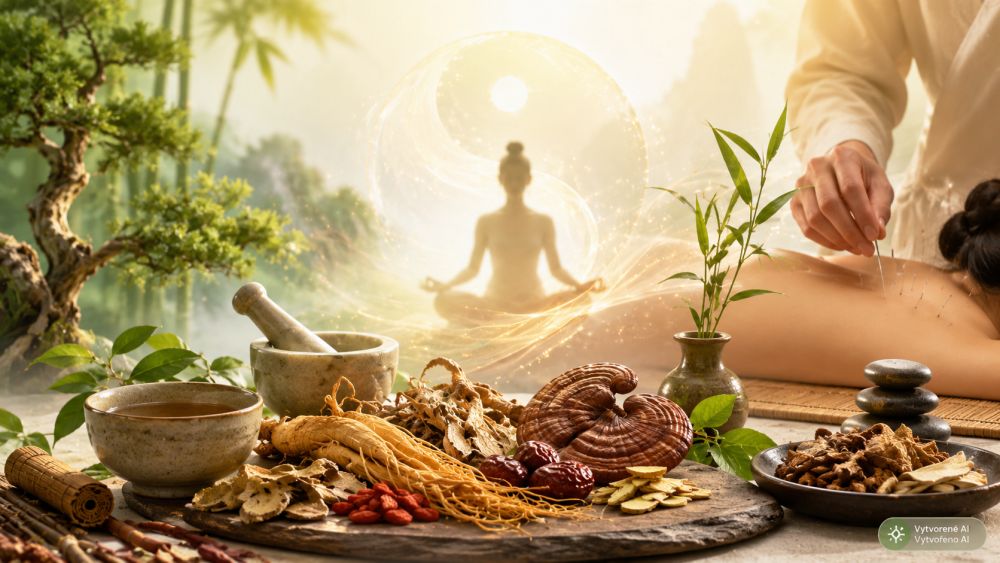
Traditional Chinese Medicine: What Can It Offer and What Are Its Limits?
Can a system developed over hundreds or thousands of years offer something to people today? Traditional Chinese medicine offers perspectives on lifestyle, movement, diet and the use of plants. However, modern science has not confirmed all of its concepts.
Author: Ing. František Kokoš and colleagues · Updated: 25 October 2026
Open the article contents
Which methods belong to traditional Chinese medicine?
Stimulation of selected points using very thin needles.
The use of plants, fungi and traditional mixtures.
Slow movement, breathing, coordination and relaxation.
Traditional manual and supportive approaches.
What is traditional Chinese medicine?
Traditional Chinese medicine, abbreviated as TCM, is a collection of practices developed in China over many centuries.
- acupuncture,
- Chinese herbal medicine,
- tai chi and qigong,
- tuina massage,
- cupping,
- traditional dietary advice,
- breathing and relaxation exercises.
TCM traditionally considers the person as a whole, including sleep, digestion, movement, daily routines and emotional experiences.
What do qi, yin and yang mean?
In traditional teaching, qi is described as “vital energy” that is said to flow through the body along meridians.
These represent two different but complementary aspects of nature and life.
Qi, meridians and the five-element system are not anatomical structures or physiological mechanisms established by modern medicine. They form a historical philosophical model.
How does TCM assess a person?
A traditional practitioner may ask about:
A traditional assessment may include examining the tongue, assessing the pulse or observing a person's overall appearance.
Tongue or pulse assessment cannot reliably rule out infection, diabetes, cancer, thyroid disorders, heart disease or other serious conditions.
Which aspects of TCM does modern science study?
Traditional Chinese medicine cannot be judged with a single verdict. Each method, plant and health condition needs to be assessed separately.
- some approaches have partially supported or promising findings,
- others have inconsistent results,
- many lack high-quality clinical trials.
Acupuncture
Acupuncture uses very thin needles to stimulate selected points on the body. Research suggests that stimulation may affect the nervous system, pain processing and the release of substances involved in pain relief.
- certain types of chronic pain,
- lower back and neck pain,
- knee osteoarthritis,
- tension-type headaches,
- migraine prevention.
Results are not the same for every condition, and acupuncture should not be presented as a universal treatment for disease.
Results also depend on the comparison group: differences versus no treatment tend to be larger than differences versus sham acupuncture. A possible effect does not establish the existence of meridians.
Even properly performed acupuncture can cause bruising or bleeding. Incorrect technique can cause infection or, rarely, serious injury. Tell the practitioner about your medicines and health conditions.
Tai chi and qigong
Tai chi and qigong combine slow movement, coordination, breathing, attention and relaxation.
For some people, these may be suitable forms of gentle physical activity. With serious joint disease, balance problems, recent surgery or acute pain, the difficulty should be adapted to the person's health.
Chinese herbs and fungi
Chinese herbal medicine uses individual plants and mixtures. Traditional formulas are often tailored to the individual.
The fact that a plant has been used for hundreds of years does not, by itself, demonstrate its effectiveness for a particular condition.
Natural does not automatically mean safe
Herbal preparations can have biological effects, which means they can also cause adverse effects or interact with medicines.
Pregnancy, breastfeeding, childhood and liver or kidney disease require particular assessment of herbal preparations. Do not combine them with treatment without professional advice.
Particular caution is needed with:- warfarin and other medicines that affect blood clotting,
- blood pressure medicines,
- diabetes medicines,
- antidepressants,
- immunosuppressive treatment,
- cancer treatment,
- medicines that can affect the liver or kidneys.
Artemisinin is a distinct case
Artemisinin was obtained from sweet wormwood, a plant used in traditional Chinese medicine. Its discovery made an important contribution to modern malaria treatment.
- wormwood can replace standard malaria treatment,
- artemisinin sold without a prescription should be self-administered,
- laboratory research establishes an effective cancer treatment in humans.
Traditional and modern medicine need not be rivals
Modern medicine is essential for diagnosing disease and managing infections, injuries, emergencies, surgery and serious illnesses.
Some traditional methods may, in certain situations, complement care by supporting movement, relaxation, pain management or quality of life.
- Establish the correct diagnosis first.
- Do not delay necessary medical treatment.
- Choose a complementary method based on available evidence.
- Check possible risks and interactions.
- Review the results over time.
When should you seek medical care?
For sudden chest pain, severe shortness of breath or signs of a stroke, call emergency services immediately. Do not wait for a TCM consultation.
Traditional approaches should not delay medical assessment, especially for:
- sudden or severe pain,
- chest pain,
- shortness of breath,
- signs of a stroke,
- unexplained bleeding,
- persistent fever,
- rapid, unintentional weight loss,
- a new lump or swelling,
- blood in the stool or urine,
- symptoms that keep getting worse.
Balance and realistic expectations
Traditional Chinese medicine highlights regular routines, appropriate movement, rest and an individual approach.
However, traditional explanations of health must be distinguished from mechanisms established by modern science.
Good complementary care should not separate people from their doctors. It should safely complement care where its benefits are reasonable and adequately supported.
Frequently asked questions
Is traditional Chinese medicine scientifically proven?
Not as a single system. Individual methods need separate assessment. Some have partial supporting evidence; others have inconsistent or insufficient findings.
Can acupuncture help with pain?
Some benefit has been investigated for certain types of pain, but results differ between conditions.
Are Chinese herbs safe?
Not automatically. Plants can cause adverse effects and interact with medicines.
Can TCM replace modern medicine?
Not for serious illnesses, infections, emergencies or medical diagnosis. Some traditional methods may complement standard care.
Further topics in traditional and natural medicine
For plants, fungi, natural substances and traditional practices, it is important to distinguish traditional use from modern research findings and consider possible risks and interactions.
Sources and supporting evidence
- National Center for Complementary and Integrative Health: Traditional Chinese Medicine – What You Need To Know
- National Center for Complementary and Integrative Health: Tai Chi – What You Need To Know
- WHO: The use of non-pharmaceutical forms of Artemisia
- NHS: Herbal medicines and complementary therapies
- NCCIH: Acupuncture – Effectiveness and Safety