

 Slovensky (EUR)
 Česky (CZK)
 Magyar (HUF)
 Slovenščina (EUR)
 Deutsch (EUR)


06. Natural GLP‑1 and Medicines: Why Their Effects Are Not the Same
GLP‑1 is a hormone naturally produced by the body. Medicines known as GLP‑1 receptor agonists, however, represent a distinct pharmacological intervention.
Why can the response to a meal not be equated with the effect of semaglutide? How do DPP‑4 inhibitors work, and what does the dual action of tirzepatide mean? This article explains the basic differences without recommending a particular treatment.
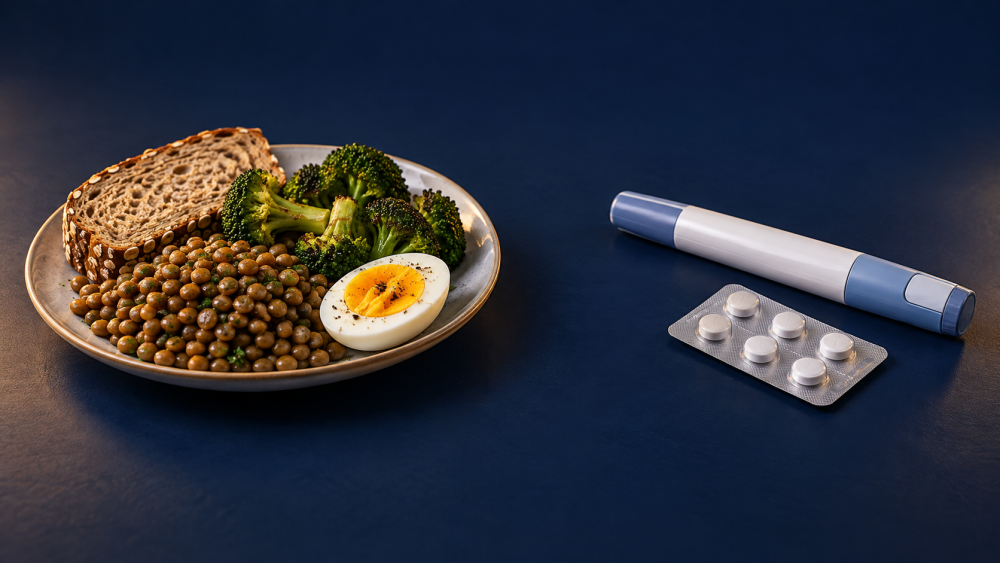
Natural GLP‑1: part of the response to food
GLP‑1 belongs to the incretin family of hormones. It is produced in the gut and helps regulate the body's response to incoming nutrients. Alongside other signals, it influences insulin secretion and glucose regulation. Its active form is rapidly broken down by the enzyme DPP‑4. [1]
It is therefore important to distinguish between releasing the body's own hormone, slowing its breakdown and directly activating its receptor with a medicine.
What does “GLP‑1 receptor agonist” mean?
An agonist is a substance that binds to a particular receptor and activates it. Semaglutide, for example, activates the GLP‑1 receptor, the same target as natural GLP‑1. Clinical effects, however, are assessed for a specific medicine, dose, route of administration and patient population. [2]
Active natural GLP-1 has a half-life of about two minutes in the blood. Without further release, its level falls by roughly half in that time. This describes hormone breakdown, rather than how long you feel full after a meal. [6]
Semaglutide is more resistant to DPP-4 and binds to albumin, a blood protein. It is broken down and eliminated more slowly and has a half-life of about one week. This allows the injectable form to be given once weekly. [2]
Treatment is therefore not simply equivalent to a meal that raises the level of the body's own hormone. A shared receptor does not mean the same duration of action or the same outcome.
DPP‑4 inhibitors: a different way to influence incretins
DPP‑4 inhibitors, such as sitagliptin, block the enzyme responsible for breaking down incretin hormones. This increases the availability of their active forms. It is not the same mechanism as that of GLP‑1 receptor agonists. [1]
Sitagliptin is used to treat type 2 diabetes. Its connection to GLP‑1 alone does not mean it has the same uses or effects on weight as other medicines acting on the incretin system.
Tirzepatide: action at both GIP and GLP‑1 receptors
Tirzepatide acts at the receptors of two incretin hormones: GIP and GLP‑1. It is therefore not simply another name for semaglutide. The EMA describes its effects on blood glucose regulation and appetite within its approved indications. [3]
Without a direct comparison, however, a dual mechanism does not establish that a particular medicine is the most suitable option for every patient. Treatment choice also depends on health status, risks and tolerability.
Comparing the basic mechanisms
| Approach | What happens? | What cannot automatically be assumed? |
|---|---|---|
| Natural GLP‑1 | The body releases its own gut hormone; breakdown also limits its activity. | That every increase in its level leads to long-term weight loss. |
| GLP‑1 receptor agonists | A medicine activates the GLP‑1 receptor; semaglutide is one example. | That the results for one medicine and dose apply to all preparations. |
| DPP‑4 inhibitors | They slow the breakdown of the body's own incretins; sitagliptin is one example. | That they have the same effects and uses as GLP‑1 receptor agonists. |
| Dual GIP/GLP‑1 agonist | It activates both types of receptor; tirzepatide is one example. | That a dual mechanism automatically makes it suitable for everyone. |
What does a clinically demonstrated effect mean?
The STEP 1 trial followed 1,961 adults with obesity, or overweight and an associated health condition, who did not have diabetes. It compared once-weekly semaglutide with placebo over 68 weeks. Both groups also received a lifestyle intervention. [4]
The average change in body weight was −14.9% with semaglutide and −2.4% with placebo. This is a group result for a specific treatment regimen, not a guarantee of an individual outcome. The trial was funded by the medicine's manufacturer, Novo Nordisk. [4]
This result cannot be attributed to a food or a food supplement. A comparable claim would require a separate clinical trial of the preparation concerned, rather than merely referring to a shared hormonal pathway.
Why are food and supplements not interchangeable with medicines?
In previous articles, we distinguished between a change in hormone levels and an actual health outcome. The same rule applies here: observing GLP‑1 release in a cell culture does not demonstrate an effect comparable to treatment in humans.
Terms such as “natural GLP‑1” or “a natural alternative to injections” can therefore create inaccurate expectations. Plant origin, a cellular mechanism or the result of an animal experiment does not establish therapeutic interchangeability.
Efficacy and safety are assessed together
Medicines affecting GLP‑1 can have adverse effects. Common effects with semaglutide include digestive problems such as nausea, vomiting, diarrhoea or constipation. Full warnings and restrictions are provided in the information for the specific medicine. [2]
The fact that some effects depend on glucose levels is not a general guarantee that hypoglycaemia cannot occur with every combination of medicines. The entire treatment regimen matters. [1]
Approval of a medicine does not mean it is suitable for everyone. For example, semaglutide has different approved uses in diabetes or weight management depending on the particular medicinal product. [2, 5]
Frequently asked questions
Does every “GLP‑1 food” automatically contain GLP‑1?
Describing a food according to its studied effect on the hormonal response does not mean it is a medicine containing GLP‑1 or an agonist of its receptor.
Are semaglutide and tirzepatide the same medicine?
No. Semaglutide activates the GLP‑1 receptor, whereas tirzepatide acts at both GIP and GLP‑1 receptors. [2, 3]
Is a DPP‑4 inhibitor a GLP‑1 receptor agonist?
No. A DPP‑4 inhibitor limits the breakdown of the body's own incretins. An agonist directly activates the relevant receptor. [1, 2]
Does an increase in GLP‑1 demonstrate an effect comparable to a medicine?
No. The specific preparation, duration of action, clinical outcomes and safety must be assessed. A hormonal change alone is not enough.
Can I replace a prescribed medicine with a supplement?
Do not replace prescribed treatment on your own. The mechanisms described do not establish that medicines and food supplements are interchangeable. Discuss any change with your prescribing doctor.
Simply put
The body's own GLP‑1, inhibition of its breakdown and activation of its receptor by a medicine are different situations. Effects are determined by the results of a specific clinical trial, not merely by the shared name of a hormonal pathway.
Continue to article 07: Sleep, stress and hunger →Curious about what’s in food supplements?
Compare ingredients, amounts per daily dose and precautions for use.
Educational purpose: This article does not recommend a particular medicine, dose or treatment regimen. It does not replace an individual medical assessment or consultation with a doctor. Current medicine information and the patient's health status are decisive.